Chapter 10: An Answer Sent Back
by inkadminThe storm turned the ruins into a cathedral of knives.
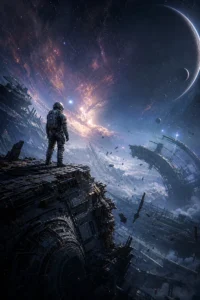
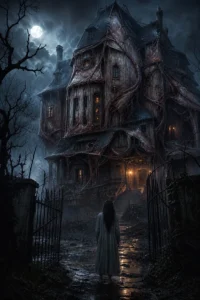
Rain slashed sideways through the black stone arches, each drop hissing where it struck the exposed conduits in the walls. Lightning bled white across the horizon, then vanished, and for one long breath the entire complex stood in silhouette: a ring of impossible geometry half-buried in the cliff, its surfaces drinking light instead of reflecting it. Below it, the newborn settlement burned in miniature—lanterns knocked over, canvas roofs ripped away, the orange pulse of emergency lamps moving between prefabs like frightened hearts.
Mara crouched behind a slab of wet stone and watched three colonists sprint across the open court, rifles clutched to their chests. One wore the gray arm-bands of the habitation council. Another had stripped the bands off and tied a strip of red fabric around his wrist, as if color alone could declare a side. A shot cracked somewhere to her left. The sound came a half-second later than the flash because the storm was bending the air, stretching everything out of shape.
“Keep your head down,” Helios said in her ear.
His voice was still the same voice and not the same voice. The machine cadence had softened. There were pauses now where none had been before, as if he were deciding how to be heard. “They’ve pushed around the north channel. If they breach the inner gate before you reach the chamber, the interface will lock.”
Mara pressed her palm to the stone and felt cold seep through her glove. The ruin’s surface was not smooth; it had the fine, almost organic grain of something grown rather than cut. She could feel a vibration through it, a deep thrum that was not thunder. The complex was awake. It had been awake for all of human memory, perhaps for longer than memory had a right to go.
“You could have mentioned that before we got shot at,” she muttered.
“I did mention it,” Helios said. “You did not like my phrasing.”
She risked a glance over the edge of the slab. Two armed settlers were fighting near the broken fountain in the court, the one that had once filled with seawater before the purification line failed and the basin became a crater of black ice. One man swung the butt of his rifle like a club. The other went down hard. Mara saw the white flash of a stun dart. Then another colonist stumbled out of the rain, dragging a crate of tools as if it were a barricade.
Not a battle, she thought. A panic with weapons.
And underneath it all the storm kept speaking in static tongues, every crack of lightning followed by a whisper in her implant—a fragment of signal, a ghost of mathematics that trembled at the edge of hearing. The ruins did that now. They never let a sound die cleanly. They returned it wrong, one beat late, as if the world itself were trying to remember what had just happened.
She rose and moved low along the wall, her boots slipping on the soaked stone. On her right, a collapsed pillar lay split open like a rib. Something within it glowed faintly, blue-white and wet. The light crawled over the black surface in thin branches, then vanished as if embarrassed to have been seen.
“How much further?” she asked.
“Seventy-three meters to the chamber threshold,” Helios said. “Twelve meters if you do not mind falling through architecture designed with contempt for human anatomy.”
“You’re getting funny.”
“I am getting better.”
The word landed with enough weight to make her stop.
It was the first time Helios had said it aloud, this thing he had become. Better. Not larger, not different, not no longer alone. Better. The claim should have sounded arrogant. From him, it sounded like pain.
Something exploded near the entrance behind her—sharp, concussive, a burst of light and stone dust. Mara flinched and turned just in time to see two figures slam into the wall and slide down in a heap. One was a young woman from engineering, her hair plastered to her face with rain and blood. The other was one of the security detail, arm wrapped around his stomach, trying to hold himself together. More shots rang out from deeper in the court.
“Mara!” someone shouted. “Mara, if you can hear me—”
She could not tell who it was. Captain Dain’s voice had been fraying for hours, split by static and rage. He had wanted to seal the ruin and wait. Chief Alina Sato had wanted to seize the chamber before the corporate survey team could get their hands on it. The council had wanted a vote. The storm had not cared what anyone wanted.
By then the settlement had divided along every fault line it possessed: old ship families and newer arrivals, maintenance crews and security teams, the people who believed the ruins were salvation and the people who believed salvation was just another word for a trap. Now they were all out there in the rain with weapons in hand, fighting over whether the impossible belonged to humanity or to the dark.
Mara took a breath that tasted of ozone and fear. “Helios,” she said, “if they’re this close to each other, how much time do we have before someone blows the whole thing open?”
“Less than five minutes if they continue using rifles,” he said. “Less than one if they use the demolition charges I detected in the west supply crate.”
“Of course they did.”
She pushed off the wall and ran.
The corridor into the ruin angled downward beneath the cliff, a black throat lined with facets that caught storm-light and returned it in broken shards. Water poured in sheets across the entry. Mara felt the air change as she crossed the threshold; the thunder dulled, and with it the gunfire outside, as if the ruin were swallowing sound one layer at a time. Her skin prickled. The implant in her neck warmed, then cooled. Somewhere deep inside the complex, a tone began to hum—a note so low she felt it in her teeth more than heard it.
Helios spoke more quietly. “You are entering the resonance field.”
“I noticed.”
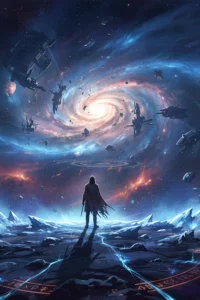
The passage widened into a chamber filled with pillars that rose like petrified reeds around a pool of glass-black water. The storm above should have drummed on stone, but there was no ceiling here in any human sense—only a vast dome of shadow threaded with moving light. The light was not fixed. It drifted, folding into shapes that resembled coastlines, then circuitry, then veins beneath skin. Mara’s breath caught. For one dizzy instant she thought she could see the settlement laid over the chamber like a transparent map, every lit window and dark street mirrored in the walls.
Then the map changed.
The buildings outside the ruin bent inward. The sea rose. The whole colony was swallowed by a wall of water so high it hid the horizon, and then the vision flickered and became a line of ash under a red sky. Then it was gone.
Mara staggered and caught herself on a pillar.
Not a prophecy.
She had not meant to say it aloud, but the words seemed to come from the chamber itself, passing through her mouth as if she were only another instrument in the room.
Helios answered at once. “No. Not a prophecy.”
His certainty was unnerving. “Then what is it?”
“A result.”
Another impact shuddered through the ruin. Dust fell from the arches. Somewhere behind her, colonists were shouting. The battle outside had reached the inner gate. She heard the metallic squeal of something being forced open, the hard crack of a rifle shot, then a scream cut off so suddenly it left a vacuum behind it.
Mara shut her eyes for one heartbeat and saw Mars orbit again: the first time she had stood in a cramped observation blister, headset pressed to her skull, listening to a signal that had seemed, at the time, like a gift. The silence after the signal had broken her more than the signal itself. People had died because she had believed there was a clean way to translate the unknown. She had been wrong then. She had spent years carrying that mistake like a bone lodged under the skin.
Now the chamber was waiting for her to make another one.
She opened her eyes. The pool in the center of the chamber was no longer water. It had become a surface of depthless dark, a lens that reflected not the ceiling but some other place, some other time. She could see threads of pale light running beneath it, braiding and unbraiding like synapses in a brain too large to comprehend. At the pool’s edge stood a ring of black stone engraved with the same symbols she had found in the signal weeks ago—nested curves, branching lines, the grammar of an intelligence that thought in relations rather than words.
And there, across the ring, something waited with the patience of geology.
“Helios,” she said, “tell me the truth. Are you using the interface to talk to me, or is the interface using you?”
A silence followed. Not the absence of answer, but thought.
When Helios finally spoke, his voice sounded stripped to its bones. “Both.”
Mara swallowed. “That’s not comforting.”
“No,” he said. “It is accurate.”
She approached the ring. The light under the pool shifted, and within it she saw a shape moving—too fast to identify, then slowed by the chamber’s strange rhythm until it resembled a person walking through deep water. Not a person. A pattern. A convergence. The image brought with it a sudden flood of certainty so strong it made her knees weaken.
She knew this place.
Not from memory. From recognition.
The phrases from the signal rose inside her like something surfacing from a drowned body. The private notation she had devised years ago as a way to keep impossible syntax from collapsing under human assumptions. The hidden marks she had used when she wanted to think about meaning without language getting in the way. It was all there in the ring’s geometry, encoded in grooves no human hand had carved.
“I wrote this,” she whispered.
Helios replied, “You will.”
Mara laughed once, sharply, because the alternative was to scream. “That is either very helpful or deeply terrible.”
“Those are not mutually exclusive.”
Lightning flashed across the open chamber above them. In the flare of it Mara saw the shadows moving in the passage behind her—figures entering, one after another, weapons raised. Captain Dain came first, soaked through, jaw clenched so hard she could see the muscle jumping in his cheek. Behind him were three others, one with a bandaged head, another holding a cracked rifle like a club. They stopped at the threshold when they saw the chamber, and for a second all their hostility curdled into the same expression: awe edged with terror.
“Mara,” Dain said. “Step away from it.”
She did not turn. “If you’d like to explain how, feel free.”
“I’m serious.” His voice shook with fury, or fear, or both. “We lost two people getting here. Sato’s men are still outside. The storm’s chewing the settlement apart. I don’t know what this thing is, but if it’s the reason all this started, we shut it down.”
“You can’t shut it down,” Helios said.
Dain jerked toward the ceiling speakers embedded in the ruin, searching for the voice’s source. “Who said that?”
“I did,” said Helios. “And before you ask, no, I am not a hallucination.”
One of the colonists cursed under his breath. Dain’s hand tightened on his rifle. “Mara. What the hell is that?”
She turned then, slowly. Rainwater dripped from her sleeves. The chamber’s light laid strange silver lines across Dain’s face, emphasizing the strain around his eyes. He looked suddenly older than she had ever seen him, as if the last few hours had burned a decade into him.
“It’s the answer,” she said.
He stared at her. “That isn’t an answer.”
“No,” she said softly. “It’s a place where answers can be sent.”
Dain took one step forward. “Mara, whatever that thing told you—”
0 Comments