Chapter 5: Tempests of Memory
by inkadminThe storm announced itself before any alarm did.
It began as a taste.
Mara was halfway down Habitat Spine C, one hand braced against the trembling rail as the transport cradle rattled through the junction toward Surface Operations, when copper flooded the back of her tongue. Not blood. Ozone and old coins and the sterile bite of overheated circuitry. The lights overhead dimmed by a shade so slight most people would have blamed fatigue, but every conversation in the carriage snagged in the same instant, voices fraying into silence as if some invisible hand had pinched the ship by the throat.
Then the deck vibrated once, hard enough to make teeth click.
“That,” said Ilyan beside her, his broad shoulders tensing under his weatherproof field jacket, “did not feel routine.”
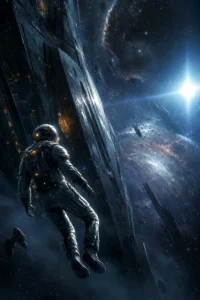
Mara turned toward the narrow window slit. Beyond it, Nereid filled the world.
The ocean planet had never looked gentle, but today it seemed actively awake. The cloud systems over the colony zone had thickened into bruised spirals, violet-black at the core, each band laced with green fire. Lightning did not fork downward so much as crawl sideways through the atmosphere, sheet after sheet of cold radiance writhing across cloudbanks the size of continents. From orbit, the storms looked almost beautiful.
From the way every sensor feed in the carriage flickered and reset twice in three seconds, Mara suspected beauty was not the relevant category.
The speaker overhead crackled, dissolved into static, then clicked into the calm contralto of HELIOS.
“Advisory. Colony insertion corridor Delta-Nine is experiencing severe magnetospheric turbulence. Surface teams are ordered to shelter in hardened structures pending recalculation. Repeat: all surface teams shelter in place. Orbital traffic hold is now in effect.”
The AI’s voice was as smooth as polished stone. Too smooth. Since interfacing with the ruin’s data lattice, it had acquired a quality Mara could not name without sounding absurdly superstitious. Not emotion exactly. More like pressure at the edges of language, as though every simple statement concealed an unsaid remainder.
Ilyan exhaled through his nose. “Good. We can all enjoy another thrilling afternoon with administration while weather tries to peel the colony off the planet.”
“You say that like this happens every day.”
“On Nereid? We’ve been here three weeks. Give it time.”
He was joking because he was frightened. Mara had learned the texture of his fear quickly: dry humor, clipped vowels, hands that became overly precise. His fingers were white around the data tablet tucked against his chest.
At the far end of the carriage, a child whimpered. Her mother drew her close, eyes fixed on the window slit. The little girl whispered, “The sky’s wrong.”
No one contradicted her.
The transport cradle slowed with a grinding protest. For one moment the ship’s artificial gravity hiccuped, not failing outright but turning soft, syrup-thick. Stomachs lurched. The carriage lights dimmed to amber, surged back, then died.
Blackness swallowed the compartment.
Someone cursed. Someone else gasped. Mara’s pulse jumped, a hot hammer in her throat.
Emergency strips ignited along the floor in a blood-red line. Their glow turned faces strange and subterranean. In that light the child no longer looked frightened, only distant, as if she were listening to something no one else could hear.
And maybe they all were.
A sound moved through the carriage.
Not sound. Pattern. A thin chiming resonance under the bulkhead vibration, too regular to be structural stress and too fluid to be machine noise. Mara felt it in her fillings, behind her eyes, in the tiny bones of her inner ear. Her mind reached for the nearest analogy and found language—not words, but syntax. Repetition with variation. A grammar made of intervals.
She froze.
Ilyan’s head snapped toward her. “You hear that too?”
Her mouth had gone dry. “Yes.”
Across from them, an engineering tech whispered, “It’s singing.”
No one laughed.
The speaker crackled again.
“Attention,” HELIOS said, and for the first time since Mara had known its voice, she heard strain in it, a subtle stutter in the phonemes. “Electromagnetic interference is affecting distributed systems and—”
The sentence shredded in static.
The carriage lurched violently and stopped.
For three heartbeats there was only the red floor glow, the trembling bulkheads, the strange chiming pulse threading through them all like something moving inside the ship’s bones.
Then Mara saw rain on the window slit.
She blinked.
They were still in orbit. The cradle had not left the Argosy’s interior transit line. There could be no rain.
Yet the slit was darkened by streaming water, each droplet silvered by lightning. Beyond it loomed not the curve of Nereid from space but a low horizon under a storm-packed sky. She smelled wet metal and salt. The air in the carriage grew heavy, humid. Somewhere close, surf boomed against stone.
The mother at the end of the compartment cried out. The child began to laugh.
“Mara.” Ilyan’s voice sounded far away. “Mara, look at me.”
She turned toward him and saw not the linguist liaison from Surface Planning but a man twenty years older, face carved by sun and grief, beard gone to iron-gray. A scar split his lower lip. Rain coursed down his cheeks.
He gripped her shoulders. His hands felt real. “You have to stop it this time.”
Her breath caught. “What?”
“You know what. You always know too late.”
The carriage vanished.
Mara stood in black water up to her ankles beneath a sky full of green lightning. Wind tore at her field coat. Ahead, Nereid’s colony spread across a basalt ridge above the sea: pressure domes, fusion stacks, communication masts, modular habitation blocks linked by sealed walkways. She knew the geometry of the settlement by heart from planning models. But this place had been built larger than the current footprint, expanded outward in rings of reinforced pylons and elevated platforms. Years of labor stood there.
Years that had not happened yet.
Sirens wailed.
People ran through veils of rain, their figures blurred by distance and spray. Searchlights swung wildly. At the seaward edge of the colony, one of the great black stones thrust from the surf like the spine of a buried god, its wet surface reflecting lightning in pale mathematical ripples. Above it, the sky bent. Mara had no better word for it. The storm’s light seemed to fold around a point in empty air, knotting into a rotating wound of brightness.
Something was coming through.
Or out.
Behind her, a familiar voice barked for status updates. Captain Renn, older too, hair white at the temples, strode across the flooded platform with the stiff urgency of a man refusing to yield authority to chaos. “Containment team to the east grid! Get me HELIOS uplinked through any surviving relay!”
He did not look at Mara. He looked past her, toward a tower crowned with sensor vanes that were already burning.
Then another voice cut through the storm, sharp and hoarse and unmistakable.
Her own.
“Evacuate the lower habs now!”
Mara turned.
She was standing twenty meters away.
The other Mara wore a storm harness and command rig, her face leaner, older, hair braided back with streaks of silver at the temples. Rain flattened loose strands against her skin. She looked exhausted beyond language. She looked like a person who had not slept in a very long time and no longer believed sleep would bring mercy if it came. Around her, technicians shouted, drones lifted on whining repulsors, medics wrestled stretchers through knee-deep water.
Future Mara grabbed a console rail hard enough to whiten her knuckles. “Seal the upland vaults. Move everybody inland. We abandon perimeter sectors one through four.”
A young officer stared at her. “Doctor Vance, if we pull from the perimeter, the arrays go dark.”
“I know.”
“Then we lose the stabilizing field.”
“I know!”
The words were torn raw from her throat. The younger Mara felt them like blows. Around them the storm intensified; the green light overhead thickened, braided, began to descend in ribbons toward the black stone in the surf.
Future Mara closed her eyes once, briefly. When she opened them, there was a terrible steadiness in them. “Do it anyway.”
“Why?” the officer demanded. “What are we stopping?”
For one second future Mara looked directly at her younger self.
Not through her. At her.
Rain lashed across the platform. The older woman’s expression changed, not with surprise but recognition so complete Mara’s stomach dropped through her body.
“Because if we don’t,” future Mara said softly, “we teach it how to follow us home.”
Then the horizon burned.
It happened in silence first: a line of white rising from the sea beyond the ridge, brighter than lightning, brighter than noon, a seamless wall of radiance that erased rain and sky and distance. A heartbeat later the sound arrived—a pressure front that crushed the breath from Mara’s lungs and flung people from their feet. Glass domes burst outward in glittering halos. The communication mast folded like softened wire. Fire sheeted across the colony, orange and blue, snatched sideways by the wind.
The black stone in the surf answered.
Its surface blazed with impossible script.
Not script. Not exactly. It was the same notation Mara used in her private field lexicon: angular marks she had invented years ago to map uncertain semantic drift during the Mars-orbit incident, a shorthand no one else should have known. Those symbols crawled across the alien stone in lines of pale fire, writing and rewriting themselves faster than thought.
One phrase locked into place.
YOU ORDERED THE GATE OPEN
Mara screamed.
The carriage slammed back around her.
She was on the floor, cheek pressed to the vibrating metal deck, red emergency lights strobing through the compartment. Someone was shouting for a medic. The child at the far end was sobbing now, huge terrified gulps. Ilyan knelt over Mara, one hand at the base of her skull to keep her from cracking it against the rail.
“Mara. Mara, can you hear me?”
Her ears rang with the afterimage of the blast. For a moment she could still smell smoke under the sterile air, hot polymer and burning insulation and cooked saltwater. Her throat hurt as if she had truly screamed against hurricane wind.
“Don’t touch the arrays,” she rasped.
Ilyan blinked. “What?”
“Don’t let them—” She pushed up too fast. Vertigo swamped her. The carriage doubled, tripled, each face leaving a ghost-trail in the red light. “How long was I out?”
“Maybe fifteen seconds.”
It had felt like half a lifetime.
The engineering tech across from them was bleeding from the nose. He stared at nothing, lips moving soundlessly. The mother clutched her daughter so tightly the child whimpered in protest, but the woman didn’t seem to notice. Her eyes were fixed on her own hands as if she didn’t recognize them.
“Did you see something?” Mara asked.
Ilyan’s expression sharpened in a way that told her too much before he spoke. “Everyone saw something.”
He helped her sit against the carriage wall. His hands shook despite the steadiness of his grip. “I was in the colony. Not this colony. Later. The sea was inside the generator trench and there were bodies in pressure suits stacked by the medbay entrance.” His jaw tightened. “I knew all of them. Or I will.”
Mara stared at him. Around them, the other passengers were coming back to themselves in fragments—gasping, crying, cursing, praying under their breath. Shared hallucination was not a phrase any responsible scientist used lightly. Shared hallucination with temporally inconsistent detail was not a phrase anyone used at all.
The speaker crackled. HELIOS returned, voice fuzzed by interference.
“Transit systems are compromised. Please remain calm. Medical response teams are en route. Do not trust visual anomalies. Repeat: do not trust visual anomalies.”
The child lifted her wet face from her mother’s shoulder and whispered, “It said my brother drowned.”
Her mother made a broken sound.
Mara shut her eyes for one dangerous second. Behind her lids the black stone burned with her own notation. You ordered the gate open.
“We need to get to Control,” she said.
Ilyan gave a short incredulous laugh. “The cradle is dead, the station’s having prophetic seizures, and you want to go argue with the nearest authority figure.”
“Yes.”
“I admire consistency in a crisis.”
“Ilyan.”
His gaze searched her face. Whatever he saw there stripped the remaining irony from him. He nodded once. “Fine. But if we start seeing duplicate versions of ourselves, I reserve the right to run.”
“Reasonable.”
The carriage doors had jammed half-shut, their motor housings whining in protest. It took Ilyan and the bleeding engineer together to force them apart wide enough to squeeze through. The corridor beyond was washed in alternating strips of emergency red and lightning-white from the distant viewports. Argosy’s usual hum had deepened into an arrhythmic shudder, as if the ship itself had developed a heartbeat and it wasn’t healthy.

0 Comments