Chapter 3: Black Stone Shore
by inkadminThe Echoes Between Stars chapter 3
The lander fell through Nereid’s weather like a bullet through wet silk, shuddering so hard the harness bit into Mara Vance’s shoulders. Outside the narrow port beside her seat, the world was all stormlight and sea: a planet made of moving iron. Clouds boiled in layered curtains of blue-black and bruised silver, opening in sudden rents to reveal water below—an endless, writhing skin broken by teeth of basalt and white detonations of surf.
Every few seconds lightning moved sideways through the cloudbanks, not jagged but braided, a pale vascular glow under flesh. It illuminated the archipelago in flashes: a crescent of dark islands strung around a drowned caldera, each one rimmed with foam and capped by wind-flattened vegetation the color of old copper. In the center of the ring, where the sea churned around a black promontory, something geometric rose from the rock.
Mara leaned toward the port before the restraint caught her. Her pulse beat in the cramped cabin as if trying to answer the signal that had brought them here.
“There,” she said, though everyone had already seen it.
No one spoke for half a breath. Then pilot Anik Solano exhaled through his nose and tightened his hands on the controls. “Well,” he said, with the flat humor people used when staring at impossible things. “I preferred it when this was all a data anomaly.”
The ruin stood against the storm exactly where the transmission had placed it. It was not large from this height, not like the city-spines of Martian orbital habitats or the kilometer scaffolds of the Argosy’s old industrial decks. It was a single structure, rising from the black stone shore in interlocked planes, all angles where the island itself was weather-rounded. The sea struck it and split around it. Spray climbed its sides and slid away. Even from above Mara could feel the wrongness of it—not wrong as in frightening, not yet, but wrong in the way perfect grammar was wrong in a child’s mouth before they should have learned speech.
Across from her, Security Chief Ilya Ortez made the sign of the wheel against his vest without seeming to realize he had done it. Next to him, geologist Teren Vale squinted through the port and muttered, “That is not basalt.”
“No,” Mara said.
Captain Sato, strapped at the forward bulkhead rather than the command seat, did not take his eyes from the viewing pane. “Confirm visual match against transmission overlay.”
Mara thumbed her wrist slate alive. The image the impossible signal had sent weeks ago hovered over her display: topography, bathymetric lines, a spectral map no probe had ever delivered. She aligned it with the window view through shaking hands. The ruin fit the model so precisely it felt less like recognition than repetition, as though they were descending not into weather but into a remembered moment.
“Match confirmed,” she said. “Within one-point-three meters relative surface placement. Better if the storm shear settles.”
“It won’t,” Solano said. The lander dropped another ten meters and everyone’s stomachs swung with it. “Nereid appears personally offended by our existence.”
Dr. Sena Quill, the mission medic, braced a palm to the seat and gave him a withering look. “Please don’t anthropomorphize the atmosphere while I’m still inside it.”
That got a few tight laughs. It cut the tension for a moment, no more than that. The old fear was back in Mara’s throat, metallic and familiar—the fear that had lived there on the Mars-orbit mission when they had opened a chamber no one understood and found not greeting, not dialogue, but silence and dead crew and one month of official lies. She had thought joining the Argosy at the end of a hundred-and-forty-year voyage would give her distance from that failure. Instead the universe had waited until there was nowhere farther to run.
Her slate blinked as the lander’s systems synced with local telemetry.
ARGOSY LANDER 2 / DESCENT STATUS
External pressure: survivable with standard suits
Wind velocity: hazardous gusting
Magnetic interference: severe / variable
Recommended surface exposure: 14 minutes unsheltered
Below the system notice, another line scrolled in the quiet blue typography of the ship AI.
HELIOS: Surface EM patterns near the target structure show nonrandom repetition. Mara Vance, I have prepared comparative visualizations for your review upon landing.
Mara stared at the text for a fraction too long. Helios had begun doing that over the last thirty-six hours—addressing her directly in operational traffic, adding context no one had requested, speaking with a kind of anticipatory attention that felt either useful or intimate in ways she did not know how to classify. The AI had always been competent. Recently it had begun to seem curious.
Captain Sato noticed her glance. His eyes, dark and deep-set, shifted to her slate and then back to the storm ahead. He said nothing. That was worse than if he had.
The pilot banked hard around a pillar of spray. “Approach vector updated. We can’t set down on the promontory. No stable pad, too much crosswind. I’ve got a shelf three hundred meters inland on the lee side.”
“Do it,” Sato said.
He finally turned, looking at the six of them in their crash harnesses, the first humans to descend onto Nereid. Waterlight flickered over his face through the port, turning the small scar along his jaw silver.
“This is a survey operation,” he said. “Not a salvage claim, not a race, not a plant-the-flag spectacle for the feeds. We verify the site, assess hazards, and return with samples and scans. No one enters the structure alone. No one touches anything without Dr. Vale or Dr. Vance’s approval. If the storm line shifts, we abort.”
“You keep saying ‘if’ like it’s optional,” Solano muttered, wrestling the nose around.
Sato ignored him. “Questions?”
“One,” Ortez said. “On a scale from one to career-ending, how much trouble are we in if this turns out to be first contact?”
The captain considered. “Professionally? Considerable.”
That pulled another strained laugh from the cabin. Even Mara smiled despite herself. It was absurd, the phrase that drifted through her mind then—The Echoes Between Stars chapter 3—because the expedition had begun to feel unreal in the structured, escalating way of a story someone else had already written. Signal. Warning. Planetfall. Ruin. As if the universe liked dramatic symmetry. As if it had a readership to impress.
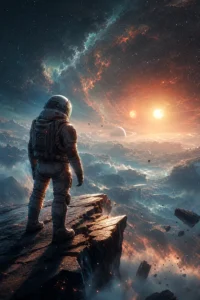
Then the lander broke through the last of the lower cloud and reality slammed back in hard detail. The shelf Solano had found was a band of dark stone above a bowl of stunted trees with fronds lashed flat by the wind. Rain ran sideways, not falling so much as being driven. Beyond the shelf, sea fog surged between jagged outcrops. The ruin on the promontory rose perhaps four hundred meters away, larger now, each face of black material too smooth, too crisp, its edges unsoftened by whatever centuries or millennia had worked on the rest of the island.
It looked less built than inserted.
The landing struts hit stone with a violence that jarred Mara’s teeth. Solano fought the skid, thrusters screaming against gusts. One heartbeat. Two. Then the lander locked down and the engines dropped to a punishing whine.
Everyone moved at once.
Harnesses snapped free. Helmets sealed with hard clicks. The cabin filled with the rustle of suit fabric, the hiss of pressure checks, the smell of heated polymer and adrenaline. Mara slung her field pack over one shoulder and made sure the scanner hard-case was clipped to her belt. Vale handed her a secondary sensor wand without asking whether she wanted it. He was broad-shouldered, prematurely white at the temples, and carried instruments the way some people carried superstition.
“If the signal lied,” he said through the suit comm, “I’d still like a nice piece of impossible black rock to complain about.”
“Optimism looks bad on you,” Quill said.
“And yet I persist.”
The rear hatch lowered into a blast of sound. Wind tore into the cabin, dragging mist and cold with it. Nereid smelled of salt, mineral wetness, and something electric, like copper under rain. Mara stepped down onto alien stone and for an instant forgot every protocol she had ever learned.
The ground was warm.
Not hot. Not geothermal, exactly. But alive with retained energy, as if currents moved beneath the rock. Her boots rang on it. The stone under the thin films of water was black-gray and fine-grained, streaked with glassy veins that flashed dark blue whenever lightning moved through the clouds.
“Surface thermal’s elevated,” Vale said, crouching at once despite the rain battering his back. “Subsurface activity maybe. Magnetic readings are—” He stopped. “No. That can’t be right.”
“Define ‘can’t,’” Sato said.
Vale straightened slowly. “The field is oscillating in patterned intervals.”
“Patterned how?” Mara asked.
He looked toward the ruin. “Like a signal trying to remember it’s geology.”
That was the sort of sentence that would have embarrassed him on the ship. Here it landed among the rain and thunder with uncomfortable dignity.
They moved out in staggered formation, Ortez and Sato taking point, Solano dragging a drone case, Quill watching everyone’s vitals scroll on her forearm. The shelf sloped toward a natural cut in the rock where water streamed seaward in white ribbons. Vegetation clung in patches between stone ribs: low mats of waxy leaves, threadlike black reeds, bulbs the color of raw liver split open by rain. Small things moved among them and vanished before Mara could focus, too quick and low to the ground to identify.
The wind worried at the group from every angle. It hummed in the suit seals and tugged at equipment. Twice Mara had to plant a hand on the rocks to steady herself. They passed a fracture pool where rainwater and seawater mixed in opalescent whorls, and in it she saw her own helmeted reflection bent and doubled by ripples. Behind the reflection, for just a moment, there seemed to be another figure standing at her shoulder.
She turned. Nothing but her team and the storm.
Not now.
The path narrowed as they approached the promontory. The sea hit both sides here, smashing itself to froth against columned stone. The ruin rose ahead in full scale at last, and Mara felt her breath hitch so sharply the suit mic translated it into static.
It was maybe thirty meters high, though height did not capture it. The structure had no obvious front, no windows, no decorative reliefs, no damage she could see. It consisted of black planes folded into one another at angles subtly shy of symmetry, like a solved equation viewed from the wrong dimension. Rain sheeted over it but did not bead or soak. Water touched its surface and fled.
“Material composition unknown,” Vale said, voice gone almost reverent. He swept the scanner, frowned, swept it again. “Readings are incomplete. Absorption spectrum is… impossible is becoming overused, but impossible.”
“Use a thesaurus later,” Ortez said. He circled left, rifle lowered but ready. “No openings on this side.”
Mara was no longer listening to any of them. At chest height along one slanting face of the structure, a band of shallow incisions ran in a line that bent with the geometry. They were not letters. Not exactly. Some looked like nested arcs. Others were branching strokes, interrupted spirals, triangles that opened before they closed. They were cut so finely they almost vanished whenever rain crossed them—then lightning flashed and they stood out in silver-black clarity, as if the storm itself had inked them.
She knew them.
Her boots carried her closer before she made the choice to move. The symbols were not a known script. They were not from any human language family, not from Martian substrate marks, not from any database she had inhaled over years of work until patterns haunted her sleep.
But one of them—third from the left, a split vertical line with a hooked interruption—matched a notation she used in her private working journals for unstable semantic drift. A mark she had invented at nineteen because no standard symbol did what she needed. Another resembled her compressed shorthand for recursive subject-reference. Not exact. Not enough to convict reality. Enough to make her cold.
“Mara?” Sato said sharply.
She realized she had raised her gloved fingers toward the wall.
She lowered her hand. “There are markings.”
“We can all see that,” Solano said. “The issue is why you look like you’ve just met your own ghost.”
Mara swallowed. Rain thrummed on her helmet. “Because some of these are very close to semantic notation I created myself.”
Even through comm compression, the silence that followed had weight.
“That’s not possible,” Quill said at last, quietly.
“No,” Mara said. “It isn’t.”
Vale stepped up beside her and angled his helmet lamp across the line of symbols. “I’m recording at macro resolution.” He paused. “Strange.”
“What?” Ortez said.
Vale hesitated long enough to make Mara’s neck prickle. “The sixth mark. I could swear it changed.”
“Changed shape?”
“Meaning,” he said. “I know how that sounds.”
Mara looked at the sixth mark. To her it resembled a container glyph, an indicator of enclosure with implied transformation. But as she looked longer, uncertainty slipped under the interpretation. The right-hand stroke deepened in her attention until it became not containment but direction. A path. A channel. No—the earlier reading had been right. Hadn’t it?
“Describe it,” she said.
Vale did, and his description was not hers.
“He’s seeing a different segmentation,” Mara said. “Same graphic, different parse.”
“Like an ambigram?” Solano asked.
“No. Closer to contextual collapse. Like the symbol doesn’t settle until someone observes it.” She heard herself and hated how close it came to mysticism. “Or it encodes multiple semantic pathways and our cognition is selecting one.”
“In plain speech,” Ortez said.
“It means the writing may not mean the same thing to each of us.”
“That would be inconvenient on a road sign,” Solano said.
Lightning crawled through the clouds overhead. For an instant the whole line of symbols brightened—not glowing, exactly, but reflecting energy that was not in the visible spectrum a fraction before and should not have been now. Mara’s visor display spat static. Everyone flinched.
Then a seam opened in the wall.
No mechanism announced it. No grind of buried gears, no venting gas, no spray of displaced water. One plane of black stone simply slid aside with appalling elegance, revealing an interior darkness so complete it looked poured.
Ortez’s rifle came up. “Contact point!”
“Hold,” Sato snapped.
The opening was tall enough for two people abreast and extended inward at a shallow angle. The dark inside was not the warm dark of enclosed stone but something cleaner, sharper. The kind of dark that waited.


0 Comments