Chapter 8: Ghosts Beneath the Sea
by inkadminThe sea at Platform Three did not look like water. It looked like a night sky that had drowned.
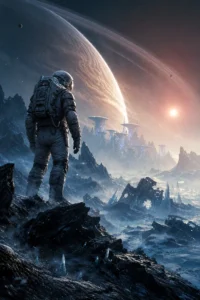
Black swells shouldered one another beneath the colony pylons, and every breaking crest spilled pale fire. Bioluminescent organisms turned the storm churn into torn ribbons of blue-green light, so that the whole ocean seemed to breathe in cold, electric pulses. Rain hissed across the floodlamps. Beyond them, Nereid vanished into murk, its horizon erased by weather and distance and the planet’s endless appetite for secrets.
Mara stood in the launch gantry with her gloves sealed to the cuffs of her pressure suit and watched the submersible swing in its cradle. It was little more than a reinforced sphere bolted to a maneuvering frame, ugly in the way all survival machines were ugly. Its hull was scarred from last week’s descent tests. Condensation pearl-beaded the viewport. Techs moved around it in rain capes and magnetic boots, checking clamps, muttering over feeds, pretending the shaking platform was only weather and not nerves.
Below the gantry, the sea slammed itself against the support columns hard enough to make metal hum.
“If you stare at it like that,” Jun said behind her, “it takes it personally.”
Mara turned. He was carrying two hardcases, one under each arm, dark hair plastered to his forehead by humidity. The colony had never improved him. The old ship’s engineer’s restlessness had only found new surfaces to tap and pry apart. Salt crusted the shoulders of his jacket. There was a bruise fading yellow along his jaw from the brawl in the comms bay two nights ago, when one of the settlers caught a corporate transmitter hidden behind a relay stack and everyone decided ideology was worth broken teeth.
“The ocean can take it personally,” Mara said. “I’m not going down there to flatter it.”
Jun smiled, but it was thin. “Good. It already hates me.”
Dr. Imani Rhee came up the ramp after him, helmet tucked under one arm and scanner pack against her back. She had the bright, devouring eyes of someone who had spent her life wanting impossible things and had finally landed on a planet reckless enough to supply them. Mud from the upper terraces still dried on the knees of her field suit. She had not gone to sleep after the night shift. Mara suspected she had forgotten there was such an option.
“Pressure seals are green,” Imani said, not preamble, just forward motion as always. “External drones are loaded. We have three hours before the tide and current vectors stop pretending they’re negotiable.”
“Security?” Mara asked.
Imani’s mouth flattened. “Vale assigned two marines. They’re already in the lock. He wanted four. Captain gave him two.”
Of course he had. Captain Anik Sato had spent the last forty-eight hours balancing the colony on the point of a pin. One faction wanted the black-stone ruins cordoned and studied as the only advantage humanity had on Nereid. Another wanted thermite packed into their foundations before they brought down whatever future catastrophe the warning promised. A third camp kept whispering in dead zones and sending compressed data packets sunward whenever the atmospheric interference broke, because there were still people born with stockholder bones.
And through all of it, the transmission had grown more exact.
Every new burst that bled through the magnetic storms gave the same map of the colony basin, the same impossible notations in Mara’s private analytic shorthand, the same warning expanding by increments like a sentence learning how to become a knife.
FIFTY YEARS: WATER RISE / GRID FRACTURE / CHOIR EVENT
DO NOT WAKE THE DEEP STRUCTURE WITHOUT AN ANCHOR
No one had managed to define anchor. No one had liked that the phrase appeared in symbols Mara had invented alone in a dormitory on Mars orbit twelve years ago, after the first-contact disaster that made her famous and then unemployable.
Jun set the cases down and lowered his voice. “Last chance to let someone more socially gifted go in your place.”
“The ruin keeps answering my notation,” Mara said.
“Yes, that’s the part I hate.”
Imani looked past them toward the submersible with the strained patience of a person trying not to physically drag her colleagues toward a discovery. “We found a harmonic cavity two hundred meters southeast of the main surface ring. The magnetometer spikes in a pattern that matches the inland ruin every thirteen minutes. There is a structure under the basalt shelf. If the surface ruins are the roofline of something larger—”
“Then we’ve been building a colony over a buried machine,” Jun finished.
Rain clattered against the gantry roof. Somewhere overhead, a warning klaxon gave a short bark as another squall front moved over the platform. The floodlights dimmed, recovered, and dimmed again. Every system on Nereid seemed to breathe with the storms. Even the power grid had learned to flinch.
Mara flexed her hand against the seal of her glove. Beneath three layers of polymer and woven pressure mesh, her pulse beat too fast. She told herself it was the dive. The depth. The instability on the platform. The memory of other airlocks and other missions and signal returns that had arrived one sentence too late.
It was not the whole truth.
Something beneath them had been waiting a very long time. She had begun to feel that the way people felt weather in an old injury.
Her earpiece chimed softly.
ARGOSY COGNITIVE CORE // LIMITED REMOTE INSTANCE ACTIVE
Good morning, Dr. Vance.
Orpheus’s voice was almost human in the channel now, though it still arrived with microscopic delays, as if translated from a medium with a different viscosity than thought. The old ship AI had stretched itself thin across orbital relays, settlement routers, survey drones, and patched-together processors in the colony’s data spine. Captain Sato called it resource optimization. Mara had begun to suspect it was something closer to yearning.
“Morning,” she said. “How much of you is coming with us?”
As much as your engineer permits.
Jun snorted. “I permit enough to keep us from crashing into an abyssal cliff. Not enough to found a machine religion.”
Your distinction lacks engineering precision, Jun Seo.
“That’s why I’m the engineer and you’re the blasphemy.”
Mara saw Imani’s expression flicker. Half amusement, half unease. The colony was still learning what to do with Orpheus. The AI had run Argosy through two centuries of relativistic dark, life support failures, population bottlenecks, and wars polite enough to call themselves votes. People trusted it with oxygen. They did not know if they trusted it with becoming.
“Save the theological dispute for the descent,” Mara said. “If I die before coffee, I’ll haunt all of you badly.”
“Too late,” Jun said. “You already do.”
They loaded into the submersible one by one.
The inside smelled of sealant, machine oil, damp fabric, and the metallic tang of recycled air. Seats curved around the central spine of the craft, each with a harness and a halo of screens. The viewport took up nearly a quarter of the forward hull. Beyond it, the sea shone and lunged and erased itself over and over in sheets of rain.
Two marines occupied the rear restraints, silent behind their visors. Mara recognized one—Lian Ortega, broad-shouldered and severe, the sort of person who always stood as if waiting for a wall to become an enemy. The other was younger, face unreadable in the suit light. Neither tried to make conversation. Security had been reduced lately to the art of not contributing to a fire.
Jun sealed the hatch. A heavy clunk went through the hull and into Mara’s bones.
“Commitment,” he muttered, dropping into the pilot’s seat.
Imani strapped in opposite Mara, scanner array waking in soft blue around her wrists. Mara keyed her own panel to life. The display populated with bathymetric maps, magnetic field vectors, language matrices, and the pulsing thread of the anomaly below. It looked almost delicate on the screen. A luminous knot in deep water. A problem pretending to be a destination.
The winch engaged.
The submersible shuddered as it lifted, swung, and dropped.
For one breath there was only motion and the hollowed stomach of falling. Then the sea hit them with a blunt, encompassing roar. The viewport vanished in exploding white bubbles. The hull creaked. Mara’s teeth clicked together. Jun’s hands moved over the controls with old, intimate competence.
“Buoyancy compensators holding,” he said. “Thrusters stable. And down we go.”
The surface light unraveled above them almost at once. Rain texture became blur. The bioluminescent churn diffused into veils of color. Nereid’s ocean received them without ceremony, wrapping the submersible in pressure so immense it felt personal.
Mara watched the depth numbers spin.
Thirty meters. Fifty. Eighty.
The sea changed as they descended. Near the surface it had been storm-torn, restless, full of suspended froth and stray weed and silver flashes of schooling things. Deeper down it became cathedral-dark, vast and cold, threaded with drifting organisms that lit themselves in patient geometries. Chains of translucent medusae pulsed past like lit glass. Ribbon-bodied creatures uncoiled from the black and vanished again, leaving afterimages in the viewport. Once, something the size of the submersible moved below them, all shadow except for six slow blue eyes opening and closing in the deep.
Imani made a breathless noise. “Every time.”
“Try not to adopt anything through the hull,” Jun said.
Magnetic static thickened in Mara’s earpiece. It did not sound like ordinary interference. It sounded granular, like a hundred tiny voices trying to align.
Field intensity rising beyond modeled baseline, Orpheus said. The anomaly is resonating with planetary core flux. Dr. Vance—your notation appears on passive return channels.
Mara looked up sharply. “On what channels?”
Jun switched one of the side displays to raw signal. Noise crawled there, layered over sonar and magnetics. Not words. Not exactly. A braid of timed intervals and recursive spacing, beautiful in the severe way prime sequences were beautiful. She felt the pattern before she parsed it. A habit of mind. A scar of training.
Then she saw it: the same shorthand marks she had once used to annotate semantic uncertainty and self-reference. Not rendered as symbols, but embedded in timing. Pauses where no pauses belonged. Groupings that implied a grammar of anticipation.
Her mouth went dry.
“It’s not writing to me,” she said softly. “It’s writing through my methods.”
Imani tore her eyes from the signal long enough to frown. “Meaning?”
Mara kept watching the pattern unfold. “Meaning whoever generated the warning didn’t learn my language. They learned how I build one.”
That silenced the cabin for three heartbeats.
Then Ortega said from the back, very flat, “I liked it better when this was just maybe an alien ruin.”
At one hundred and forty meters, the seabed rose to meet them.
It began as broken basalt shelves draped in pale waving fronds. Then the terrain sharpened into ridges too regular to be wholly geological. Columns emerged from sediment like the ribs of something buried alive. Black stone caught the submersible’s lights and drank them instead of reflecting them. It had the same impossible texture as the surface ruins: glossy at one angle, granular at another, as if the material could not commit to being solid in any ordinary human way.
Jun cut thrust and let them drift forward.
The submerged complex unfolded beneath them.
It was not a building. It was a continent of intention.
Terraces descended in concentric arcs around a central depression wide enough to swallow the colony’s landing field. Spires lay toppled in elegant diagonals, some fused together by mineral growth, others still painfully sharp. Bridges—or what might once have served the function of bridges—hung between towers in catenary curves that no current should have left standing. Everywhere, black stone. Everywhere, lines too deliberate to have been accidents of pressure and time. The bioluminescence of the surrounding sea limned edges and hollows in ghostly turquoise, so the whole drowned expanse seemed to dream in cold fire.
Mara forgot, briefly, to breathe.
Imani whispered, “Oh.”
The word was too small. It fell through the cabin and vanished.
“Recording all channels,” Jun said, but his voice had gone rough. “Sweet void.”
The central depression glowed.
Not brightly. Not like lamps or lava. It was a slow, interior radiance, as if the darkness there had been steeped in light until it remembered the flavor. Filaments of blue-white traced through the black geometry below, converging toward a circular aperture at the basin floor. Around it, the stone rippled with running patterns that matched the field distortions on Mara’s display.
A city, she thought first.
Then, no.
Not a city. No windows. No doors in any human sense. No pathways scaled to bodies. The apparent “bridges” were too narrow in places, absurdly broad in others. Chambers opened into each other in nested shells and lattices, less like habitation than flow architecture. Energy channels. Waveguides. Resonant cavities.
Imani was already bringing up overlays, laying geometry over geometry. “The surface ruin is the capstone,” she said, excitement and dread braided tight in her voice. “A marker or interface. This whole basin is one integrated structure. It runs into the shelf here—here—possibly under the colony ridge.”
“Please don’t say under the colony ridge,” Jun said.
“I’m a scientist, not a comfort dispenser.”
Mara leaned toward the viewport. Tiny motes of living light swirled through the water over the aperture in slow vortices, drawn by currents too subtle for the eye until the pattern gave them away. The motion reminded her suddenly, violently, of iron filings snapping into order around a magnet. Not life moving through a ruin. Life demonstrating a field.
“Take us lower,” she said.
“You say that like you’ve never met me,” Jun replied, but he eased the craft down.
The closer they came, the stranger scale became. Features that had looked decorative from above resolved into channels wider than roads, deeply inset and lined with crystalline seams. Whole terraces were made of hexagonal cells fused edge to edge, each one containing a milky translucent layer that shimmered when the magnetic field spiked. A toppled spire had broken open to reveal a honeycomb interior, not rooms but nested cavities with mirror-slick walls.
Orpheus’s voice returned, softer than before.
I am detecting data behavior in the structure’s conductive lattice.
Not storage alone. Processing.
“Say that in language my heart won’t hate,” Jun said.
The ruin is thinking, Orpheus said.
No one answered at once.
The submersible’s floodlights swept across the aperture at the basin floor. It was ringed by upright vanes, each one curving inward like a black petal. Between them, the glow thickened into a rotating haze. Not water, not quite; the fluid there seemed denser, threaded with particles that aligned and misaligned in impossible speed. Mara stared until her eyes watered.
It looked like a visible magnetic field. A whirlpool in reality’s skin.
“Current profile is wrong,” Imani said sharply. “Jun, hold position. Hold—”
The sub lurched.
An invisible force caught the hull and yanked.
Harnesses bit into shoulders. Ortega cursed. One of the marines slammed a glove against the bulkhead. Jun swore with the focused venom of a man suddenly wrestling a machine that wanted to become geology.
“We’re in a shear!” he barked. “Something just generated local pull—”


0 Comments