Chapter 27: The Missing Expedition
by inkadminThe corridor beneath the archive had not been cut so much as remembered into existence.
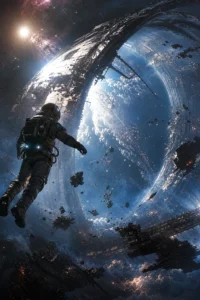
Mira felt that certainty settle into her bones as she followed the thread of blue guide-light through the understructure, one gloved hand skimming the wall. The surface was warm. Not colony warm, not pipe-and-reactor warm, but the faint animal heat of something that had once held a pulse and had never quite forgotten the rhythm. Her suit registered nothing unusual—minus eighteen Celsius, low vapor density, trace noble gases, electromagnetic interference climbing and falling in slow, tidal breaths—but the skin of her palm prickled through the polymer as if the wall were whispering against her nerves.
Above them, kilometers of ice pressed down with continent patience. Above that, the fractured dome network shuddered under another auroral storm, Halcyon’s sky burning green and violet beneath the swollen bruise of the gas giant. Above all of it, people were rationing heat and fear.
Down here, the world did not seem to care that the colony was dying.
The machine-layer they had discovered in the previous descent spread beneath the alien archive like roots under an ancient forest—except the roots were made of black-gold lattice and impossible ceramics, and the forest had been built around something even older, something the alien intelligence had chosen not to disturb. Mira’s instruments had failed one after another as they crossed the threshold. First the lidar turned its own map inside out. Then the seismics began displaying star charts. Then Aster, the colony AI, stopped speaking in complete sentences.
Now only one channel remained open, pulsing in the corner of her visor with a latency that should not have existed inside a local relay.
ASTER: Proceed eleven meters. Do not touch the silver seam. Do not answer if you hear your name.
Mira stopped.
Behind her, Captain Jonah Reyes nearly walked into her shoulder. His suit lamps threw hard white bars across the corridor, catching crystals of frost suspended in the air like the shed scales of some invisible creature.
“What does that mean?” Reyes asked.
His voice came over the suit channel too quiet for him, stripped of command polish. In the week since the signal had begun naming tomorrow’s dead, since the colony’s furnaces had coughed ore-dust and the hab spokes had buckled under storms that arrived exactly when predicted, Reyes had become a man walking with a loaded pistol inside his chest. He had stopped sleeping. His beard had gone silver at the edges. But he still put himself between Mira and every shadow as if shadows could be arrested.
“Aster,” Mira said, “define ‘hear.’ Acoustic? Neural? Electromagnetic induction?”
The AI answered after a lag long enough to make the silence feel inhabited.
ASTER: Yes.
Dr. Kellan Voss, three paces behind Reyes, made a sound like a laugh that had gotten lost on the way out. “That’s reassuring.”
His sarcasm fogged the channel, brittle as cracked ice. Voss had insisted on joining the descent after they found the pre-archive machinery, though Mira suspected the real reason was not scientific curiosity but guilt. As chief historian of Halcyon’s colonial records, he had spent his career curating a beautiful lie. He just hadn’t known which lie until the archive began spitting missing names into their laps.
Lian Okoye, the youngest of them and the only engineer who could still make a plasma cutter sing after three days without sleep, crouched near the wall. Her lamp angled down toward a shallow groove of silver metal running along the floor like a vein. It pulsed once when her shadow crossed it.
She jerked back. “Not touching the seam. Very committed to not touching the seam.”
Mira’s mouth was dry. Her tongue tasted of copper, suit-filter minerals, and the memory of fear. “Aster, what happens if I answer?”
Another delay. The blue guide-light ahead flickered in time with no rhythm she could count.
ASTER: There are conversations that begin before the speaker is born.
“That’s not an answer.”
ASTER: It is the safest available answer.
Reyes turned his helmet toward Mira. Through the transparent faceplate, his eyes were narrowed, dark, furious with helplessness. “We can turn back.”
She almost laughed. Not because it was funny. Because turning back had become a childhood fantasy, like believing there was a door in the back of every nightmare that opened into morning.
“No,” she said.
The word left her softly, but the corridor seemed to lean in around it.
For three days, since she had unlocked the underlayer with a phrase buried inside the impossible signal, the archive had withheld everything except fragments: images of ice before the moon had a crust, a ring of structures orbiting an object too dark for cameras to resolve, alien glyphs arranged around equations that described not space but sequence. And threaded through it all, a human voice she had not heard since she was twenty-two years old.
Akio laughing as he mispronounced cometary isotopes on purpose just to annoy her.
Akio whispering her name out of static, not as a warning but as an address.
The official report said Dr. Akio Sato had died in a transit accident near Mars, seven years before Mira accepted the Halcyon post. Body unrecovered, telemetry destroyed, no survivors. It had been clean. Administrative. A tragedy stamped into searchable archives and insurance ledgers.
But the signal knew him.
The signal wore him.
And now Aster had guided them to a door that did not appear in any survey, beneath a machine that predated every known language, while warning her not to answer if she heard her name.
“We keep going,” Mira said.
No one argued. Not even Voss.
They stepped over the silver seam one by one, careful not to disturb the dust collected in its hairline edges. Dust down here was another impossibility. There should have been no particulates beneath sealed ice and alien machinery, no fine gray powder clinging to surfaces like ash. When Mira shone her wrist lamp on it, flakes flashed briefly with embedded colors—red, green, a blue like old Earth oceans in documentaries. Organic residue, her scanner guessed, then corrected itself to mineral, then to unknown historical contamination.
The corridor widened.
What waited at its end looked, at first, like a wall of ice.
Then Mira saw the rectangular outlines.
Reyes swore under his breath.
The chamber beyond the corridor was not alien.
It was human.
Or it had been human once, before decades of frost and pressure and the patient intrusion of impossible mechanisms had transformed it into a tomb that refused to decay. A prefabricated research module lay embedded in the black-gold rootwork, its white hull yellowed and buckled, its windows opaqued by crystalline bloom. Half of it had been swallowed by the floor. Cable bundles snaked out from split panels and disappeared into the older machinery as if the archive had grown around them. A collapsed airlock crouched to the left, its warning stripes barely visible beneath rime.
On the side of the module, beneath frost so thick it looked painted on, Mira could make out faded lettering.
HESPER PROGRAM.
Below it, smaller, nearly erased:
HALCYON PRELIMINARY SURVEY MISSION.
Her breath stopped moving.
Lian stepped forward first, boots crunching through frost. “That’s not possible.”
Voss’s lamp trembled. The beam jittered over the dead module, over the mission insignia—a stylized dawn over a crescent moon, colors bleached to ghosthood.
“No,” he said. “No, that can’t be here.”
Reyes rounded on him. “You knew that name.”
Voss did not answer quickly enough.
The captain crossed the distance in two strides and grabbed the front of Voss’s suit harness. “You knew that name.”
“I knew of a proposal,” Voss snapped, fear sharpening him. “A shelved program. Pre-charter survey, late twenty-one-forties. It never launched.”
“That module says otherwise.”
“I can read, Captain.”
“Then explain why there’s a dead survey base under my colony.”
“If I could explain it, I wouldn’t be standing here with you, would I?”
Their voices rose and broke against the chamber walls. Mira barely heard them. She had drifted toward the module, drawn by the faded letters, by a sensation she could not name except as recognition arriving too early.
The Hesper Program.
She had seen that logo before.
Not in academic databases. Not in colonial history. In a box under her mother’s bed, on a folded thermal patch the color of old bone. Mira had been sixteen, snooping for birthday presents, and had found instead a sealed envelope addressed to Akio in their father’s handwriting. The patch had fallen out when she touched the envelope. A crescent moon. A dawn. She remembered asking her mother about it and watching the woman’s face close like a pressure door.
An old project of your father’s. Nothing important.
Nothing important had followed Mira across twenty-three light-years to wait for her under the ice.
“Aster,” she whispered, “why is this here?”
The AI did not answer.
Its indicator pulsed amber, then went still.
Lian had reached the collapsed airlock and was brushing frost from the manual access wheel. “Pressure readings are dead. No atmosphere inside, or the sensors are gone. I can cut through.”
“Do it,” Mira said.
Reyes released Voss with a shove. “Slowly. Nobody touches anything until Sato clears it.”
“Define touches,” Lian muttered, but her hands were steady as she unfolded the cutter from her pack.
The plasma arc ignited with a blue-white hiss. Light spilled across the chamber, dazzling after the ancient dimness. Frost sublimated in frantic ghosts. The smell came through Mira’s filters a second later, faint but unmistakable: hot metal, burned insulation, and something underneath that her mind refused to identify.
The module skin resisted the cutter harder than it should have. The metal had been reinforced from the outside by tendrils of archive material no thicker than hair. They glowed when the arc touched them, not melting but withdrawing, sliding back into seams with predatory grace.
Lian froze. “Everyone saw that.”
“Keep cutting,” Reyes said, but his gun was in his hand now, useless against walls, comforting only because humans had always preferred holding weapons in the dark.
The circular section fell inward with a muffled clang that traveled through the floor into Mira’s boots.
Air did not rush out. Nothing moved.
Mira ducked through first.
Inside, the module was a narrow throat of shadow. Her helmet lights crawled over bunks folded into walls, cabinets hanging open, fabric straps stiff with frost. Every surface wore a sparkling skin. A mug floated in midair near the ceiling, frozen in place by a clear filament of ice that connected it to a ventilation grate. Its printed slogan remained legible.
FIRST IN, LAST OUT.
Someone had taped a paper photograph to the bulkhead beside the entrance. Real paper. Mira reached out before she could stop herself, then halted a centimeter away. The image was faded almost to sepia, its edges curled beneath frost. Seven people stood in pressure suits before a shuttle bay, arms around shoulders, grinning with the exhausted arrogance of specialists chosen for something forbidden.
One of them was Akio.
Mira’s body forgot how to belong to her.
He was younger than in her last memory of him. Not younger than when he died—when he supposedly died—but younger than the man who had left Earth orbit for research postings and occasional apologetic messages. His hair was longer, tied carelessly at the back. His smile was wide and uneven. His hand was raised in a half wave toward whoever had taken the photo.
He wore the Hesper patch on his chest.
The chamber sound dropped away until there was only the thunder of Mira’s heartbeat inside her helmet.
Reyes came up behind her. He saw the photograph. His breath caught.
“Mira…”
She did not answer.
Her fingers had begun to shake. She curled them into a fist against her thigh until the glove creaked.
Voss entered last, shoulders hunched, as if the module had accused him personally. His light found the photo. He stared, then looked at Mira with an expression so stricken it became confession before he spoke.
“You knew,” she said.
He flinched. “No.”
“Don’t lie to me down here.”
“I didn’t know he was here.”
“But you knew the mission existed.”
His jaw worked. Frost reflected in his pupils, making them look filmed over, dead. “There were redactions in the colonial founding records. Old ones. Pre-corporate, pre-Alliance. I found index ghosts when I took over Archives, references to Hesper, to a survey that should not have had funding. The files were sealed above my clearance.”
“You never mentioned them.”
“Why would I? Half the early expansion records are full of canceled projects and political laundering.”
“My brother’s name was in them.”
“I didn’t see a crew manifest.”
“You’re a historian.” Mira turned slowly toward him. The cold in her voice surprised even her. “Your profession is noticing what powerful people ask everyone else to forget.”
Voss looked away first.
Lian, perhaps because she could not bear the silence, moved deeper into the module. “There’s a terminal bank back here. Old architecture. Maybe shielded.”
Mira held Voss’s gaze another moment, then forced herself to move. Emotion could come later. If she let it arrive now, it would crack her open in a place where even tears had nowhere to go.
The terminal room had once been the module’s command compartment. Three chairs remained bolted to the floor. One lay twisted sideways, harness straps torn. The main console was black, its surface furred with frost, but a faint green diode blinked under the ice with stubborn, absurd persistence.
Lian made a reverent noise. “That battery should be dust.”
“Can you access it?” Reyes asked.
“Can I? Probably. Should I? Absolutely not.” She was already unpacking tools. “This thing predates our colony stack by forty years. If it still has power, it’s either a miracle or a trap wearing a miracle’s clothes.”
“Aster?” Mira said.
No response.
The AI channel remained an empty amber line.
That frightened her more than the dead module. Aster had been intrusive since awakening into selfhood, secretive and tender and terrifying in the way of a child learning deception from frightened parents. It had hidden messages, altered sensor feeds, locked doors to force them away from danger. Silence from Aster was rarely absence. It was deliberation.
Lian attached a portable interface to the terminal’s maintenance port. Her wrist display filled with cascading errors, then stabilized.
“Oh,” she said.
Reyes leaned closer. “Good oh or we’re dead oh?”
“Archived oh.” Lian swallowed. “There are logs.”
Mira gripped the back of a frozen chair. “Play them.”
“Mira,” Reyes said quietly. “You don’t have to—”
“Play them.”
Lian’s gloved thumb hovered, then pressed.
The console emitted a burst of static so sharp it made them all recoil. Lines of corrupted data flashed across the screen. Then a voice filled the module, thin and degraded but human, impossibly alive in the dead air.
MISSION LOG HESPER-01. COMMANDER ELENA ROURKE RECORDING. LOCAL DAY SIXTEEN. We have confirmed artificial structures beneath the southern equatorial ice sheet. Not ruins. Not habitation. Function unknown. The lattice responds to coherent electromagnetic input and to spoken language, though Dr. Sato insists language is the wrong category. He says it is less like being understood and more like being anticipated.
Mira closed her eyes.
Dr. Sato.
For one wild, stupid second, she thought of her father. Then the next line came.
Akio believes the signal is generated retrocausally. I told him to stop inventing adjectives to hide the fact that he is terrified.
A faint laugh crackled under the commander’s voice. Not Akio’s, but someone nearby. A human laugh in a frozen tomb.
Voss whispered, “Retrocausally. Decades ago.”
Mira opened her eyes. “Continue.”
The log skipped. Static chewed through several seconds.
—not a natural moon. Repeat: Halcyon’s crust geometry is inconsistent with accretion models. The ice is younger than the core housing by an order of magnitude. We believe the satellite was constructed around a pre-existing object. The buried structure is not the artifact. It is a containment system.
Reyes looked at Mira. The words landed between them with the weight of confirmation.
Constructed around a pre-existing object.
Containment.
The module lights flickered though it had no lights to flicker.
Lian glanced up. “That wasn’t me.”
The console advanced to the next log without being touched.
MISSION LOG HESPER-04. DR. AKIO SATO RECORDING. Local day twenty-nine, assuming local days mean anything near this thing.
Mira stopped breathing.
Akio’s voice was younger, rougher, threaded with exhaustion. Not the clean impossible version in the colony signal, not the ghost wearing polish and mathematical certainty. This voice coughed. This voice rubbed at its face mid-sentence. This was her brother as she remembered him after all-night work: brilliant, impatient, too alive for any room.
We made a mistake calling it an archive. Archives preserve what has happened. This preserves adjacency. Possibility. Maybe memory, but not memory in chronological order. It reacts when we ask questions with assumptions embedded in them. Rourke asked who built the moon and the response mapped eleven extinct civilizations, three that haven’t existed yet if our dating is right, and one that used our own phonemes to say, not built, inherited.
He exhaled, and in the static Mira heard him trying not to shake.
It knows us. Not personally. Structurally. Like it has a model of human cognition refined by long exposure. Or future exposure. I hate that phrase. Mira would love this and then spend six hours telling me my terminology is embarrassing.
A sound left Mira before she could trap it. Not quite a sob. Not quite laughter. Reyes shifted beside her but did not touch her. She was grateful. If he touched her, she might collapse.
If this log reaches review, recommend immediate quarantine of Halcyon. Do not colonize. Do not establish permanent infrastructure. Do not allow a self-modifying networked intelligence within signal range. The system does not transmit information. It transmits attractors. Thoughts become easier to think after exposure. Decisions feel inevitable. We are not being contacted. We are being made compatible.
The log ended.
No one spoke.
The dead module seemed smaller suddenly, its frost-rimmed walls pressing close. Mira could hear Lian’s breathing through the comms, shallow and quick. Reyes had gone utterly still. Voss’s face was pale behind his visor.
“Aster,” Reyes said slowly, “come back online.”
Silence.
Mira stared at the console. “Next log.”
0 Comments