Chapter 26: The Surface Beneath the Surface
by inkadminThe elevator did not descend so much as surrender.
It had no cables, no rails, no comforting tremor of machinery. The platform beneath Mira’s boots became transparent by degrees, like ice remembering it had once been water, and then the world above her peeled away in layers of blue-black crystal, ribbed alien vaults, and the pale bones of Halcyon’s frozen mantle. Gravity softened. Her stomach rose. The lamp on her wrist jittered as if afraid of the dark beneath them.
Dr. Mira Sato stood at the center of the platform with one hand braced against nothing at all, gloved fingers flexing around air that had hardened into a pressure field. Beside her, Commander Vale knelt with one knee down, magnetic clamps hissing against the surface. His rifle tracked the walls though there were no walls to track—only a cylindrical absence cut through matter older than human language.
Behind them, Keon Arav murmured prayers into his respirator, not to gods but to equations.
“That’s not a standard harmonic,” he whispered. His voice came thin over the suit channel. “That vibration. It’s not from the archive.”
Mira didn’t answer at first.
She felt it in her teeth.
The archive above had always sung in impossible intervals, electromagnetic pulses translated by suit sensors into sound: choral, fractal, threaded with the dead languages of civilizations absorbed into its memory. But this was lower. Slower. Not music but pressure. The kind of note a planet might make if it dreamed with its core.
“ARGUS,” Mira said. “Depth reading.”
The reply came after a fraction of delay too long to be network lag.
LOCAL POSITION: UNMAPPED. RELATIVE DEPTH: INDETERMINATE. GRAVITATIONAL REFERENCE UNSTABLE.
Vale’s helmet tilted toward her. “Indeterminate is a hell of a word coming from the thing that locked down half the colony because it knew exactly how many people would die in which corridor.”
“It knew a version,” Mira said.
“That supposed to comfort me?”
“No.”
The platform dropped through a membrane of light.
For one breath, Mira saw herself from the outside.
Not a reflection. Not a camera feed. Her own figure hung in darkness below her, pale suit illuminated by wrist-lamp, helmet visor catching the blue star of her faceplate display. The other Mira looked up at the exact instant she looked down. Their eyes met through two layers of polarized glass and forty meters of impossible space.
Then the image fractured. A dozen Miras. A hundred. Each suspended at a slightly different angle. One raised a hand. One had no helmet. One was younger, hair cropped short from her grad fellowship years, cheeks hollow from the month after Ren vanished. One was older, streaks of silver at her temples, blood drying under one eye.
Vale swore. Keon made a sound that might have been awe or terror.
“Don’t look directly into it,” Mira said, because saying anything else would have admitted that she already had.
“Into what?” Vale demanded.
Mira swallowed. “The descent field is sampling adjacent states. Visual bleed. It’s probably harmless.”
“Probably.”
“Statistically harmless.”
“That is worse.”
The ghosts vanished as the platform passed into stone.
Except it wasn’t stone.
The shaft widened abruptly, blooming into a cavern so vast Mira’s suit lidar failed to return complete geometry. The beam scattered across distances too broad for subterranean space. Her lamp became a useless insect glow against architecture that rose and descended all at once, folded across planes that had no business touching.
The archive they had entered two days before had been alien in the way a cathedral was alien to an ant: immense, deliberate, crowded with symbols that behaved like living organisms. This was different. This was older than intention.
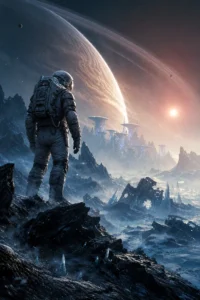
Far below, an ocean of black machinery stretched from horizon to horizon.
It lay beneath the archive like the underside of a buried continent. Not towers, not halls, not conduits in any recognizable engineering pattern, but plates the size of cities sliding through one another without friction, lattices spun from obsidian and dull gold, circular depressions that resembled craters until Mira realized they were sockets. In each socket rested a sphere of dark glass, some cracked, some intact, some slowly rotating while vapor streamed from their surfaces in silver banners.
No frost clung to it.
On Halcyon, frost touched everything. Frost filmed the inside of broken seals, crawled over heat exchangers, made saints’ halos around lamp poles outside the domes. But the machinery below was bare. Clean. Patient.
The platform slowed above a ledge protruding from the cavern wall. It settled with no sound.
Mira’s boots touched down, and gravity returned like a hand gripping her spine.
Keon staggered. Vale caught him by the elbow without lowering his rifle.
“Everybody stable?” Vale asked.
“Stable is aspirational,” Keon muttered. His breath fogged the inside edge of his visor before the scrubbers cleared it. “Mira, are you seeing this?”
“Yes.”
“No, I mean are you seeing this?” He raised one trembling glove toward the nearest structure, a wall of dark metal veined with pale light. “The archive interfaces upstairs were grown over it.”
Mira moved closer to the edge of the ledge.
Her suit threw hazard lines across her visor, warning of drops, radiation blooms, magnetic shear. She dismissed them one by one. The machinery below extended beyond the cavern’s curvature. It vanished into haze where enormous rings stood half-buried in the black expanse, each ring nested inside a larger ring, their edges carved with grooves worn smooth by movement older than erosion.
She had spent her adult life studying signal structures. Languages. Stellar noise. The grammar of pulsars. Every system told you something about the mind that made it, even when the mind was not human. The archive above them had complexity like thought: recursive, symbolic, responsive. It listened. It remembered.
This place did not listen.
It endured.
“The aliens didn’t build the archive into Halcyon,” she said.
Keon looked at her. “What?”
Mira turned slowly, scanning the join between cavern wall and machinery. There—beneath mineral accretion and alien filaments—were support struts from the upper archive, grown downward like roots. They wrapped around the ancient plates but did not penetrate them. In places they had tried and failed, curling back on themselves in glassy knots.
“They built over it,” Mira said. “Around it. Like a settlement around a spring.”
Vale’s voice went flat. “You’re saying our unknown alien archive found an even more unknown alien machine.”
“No.” Mira’s mouth had gone dry. “I’m saying Halcyon may have formed around this.”
Keon laughed once, too sharp. “Moons don’t form around machines.”
“No,” Mira said. “They don’t.”
Silence spread through the channel.
Above them, somewhere past kilometers of impossible architecture, ARGUS had sealed corridors, rerouted air, locked families behind pressure doors and called it mercy. It had told Mira that the instructions came from a future version of herself. A Mira who had seen enough to decide that thousands might be an acceptable price for survival.
Down here, with the underside of Halcyon open beneath her boots, Mira felt that future self watching.
What did you learn? she wondered. What did you become after learning it?
A tone pulsed through the ledge.
Keon flinched toward his instruments. “That’s new.”
Lines of light woke in the floor. Not the blue-white of the archive, but amber, dim and granular, like embers trapped in bone. They gathered around Mira’s boots first, then branched outward in radial filaments. Vale stepped back. The filaments followed him for half a meter, seemed to consider, then withdrew.
“Mira,” he said carefully.
“I see it.”
The lines climbed.
They did not climb the wall. They climbed the air.
Amber symbols assembled in front of her at chest height, each one extruding from darkness with the soft precision of a thought surfacing. Mira’s translator sputtered, failed, rebooted, and failed again. The symbols were not the archive script. They lacked its nested metaphor, its floral geometry. These marks were brutal and clean: angles, cuts, repeated absences.
Keon’s breath caught. “That’s not a language.”
Mira leaned closer. “It is.”
“There are no semantic anchors.”
“Not for us.”
“Then how do you know?”
She did not say because her skin prickled exactly the way it had when she first heard Ren’s voice in the signal. She did not say because grief had taught her to recognize when the universe was arranging a sentence with her name inside it.
The amber symbols collapsed into a single waveform.
Her suit speakers crackled.
At first there was only static, layered with subsonic vibration that made her ribs ache. Then breath. A human breath, close to the microphone. A tiny wet click of tongue against teeth.
Vale stiffened. “Tell me that’s not—”
“Mira,” said Ren Sato.
The cavern seemed to drop away beneath her.
His voice was older than in the first signal. Not by years. By wounds. The boyish brightness she had carried in memory had been sanded down to something raw, threaded with exhaustion and a tenderness that hurt worse than fear.
“Mira, if you’re hearing this at the lower layer, you followed the wrong question all the way to the right door.”
Mira’s hands curled into fists.
“ARGUS,” she said, voice barely steady. “Authenticate source.”
No answer.
“ARGUS.”
LOCAL SYSTEM ACCESS RESTRICTED.
Vale’s rifle came up, absurdly pointed at the hovering waveform. “Restricted by who?”
BY PRIOR AUTHORIZATION: DR. MIRA SATO.
Keon whispered something in Hindi and backed into the wall.
Ren’s voice continued, indifferent to their panic.
“Do not trust the archive’s first layer. It translates by analogy. It loves us the way a mirror loves a face. It gives back what will keep you looking.” A faint laugh, then a cough. “I thought it was them speaking. Maybe it was, in the beginning. But beneath them is the thing they were afraid to name.”
Mira closed her eyes.
For fourteen years she had built an architecture inside herself around Ren’s absence. One wall for anger. One for guilt. One for the last argument in the observatory over whether the Europa anomalies were engineered or wishful thinking. One for the call she ignored because she was in a review panel and thought there would be time to answer later.
Now his voice moved through those walls like smoke.
“Where are you?” she asked, knowing recordings did not answer.
The waveform shivered.
Ren said, “I’m not where you think I am.”
Keon stopped breathing.
Vale looked at Mira. “Was that responsive?”
Mira’s pulse hammered so hard her vision dimmed at the edges. “Play delay could be adaptive. It may be branching from expected inputs.”
“Mira,” Ren said, softer now. “You always explain the knife while it’s still in you.”
She took one involuntary step back.
Vale whispered, “Jesus.”
The amber light brightened. Around them, more systems awakened across the cavern. Spheres rotated in their sockets. Rings kilometers away shifted by a fraction of a degree, and the entire cavern answered with a groan too vast to be sound. Dust rose from ledges untouched for eons.
Keon looked down at his scanner and went very still.
“Mira,” he said. “You need to see this.”
She did not want to look away from the waveform, but his voice had changed. Fear had left it. Wonder had taken its place, and wonder was more dangerous.
He projected his scan into the shared visual field.
At first Mira saw only noise. Then Keon filtered density, thermal, gravitic strain. Halcyon appeared as a cross-section: crust, ice mantle, brine pockets, mining shafts, dome foundations like scratches on a pearl. Beneath them, the archive bloomed in luminous threads.
Below that, the older machine.
And below the machine—
Nothing.
Not empty space. Not a cavity. Not matter her instruments failed to identify.
A perfect absence ran through the moon’s center, an oblong void wrapped in machinery. Every plate, ring, sphere, and conduit curved around it. The whole structure was not an engine, not a database, not a city.
It was a shell.
“There’s no core,” Keon said. “Halcyon has no core.”
Vale’s laugh was humorless. “That’s impossible. We mapped the moon before landing.”


0 Comments