Chapter 42: Into the White Core
by inkadminThe door beneath Halcyon did not open.
It remembered how to be open.
Mira watched the seam in the glacier floor dissolve without movement, without sound, without the grinding hydraulics or warning strobes she had come to associate with every constructed thing humans trusted their lives to. One moment there was a slab of blue-black ice veined with mineral scars, the next there was a circle of absolute white cut into the world, as if a star had been set underneath the crust and persuaded to wait.
The light did not spill. It stood.
It had weight. It pressed against her visor, seeped around the edges of her thoughts, crawled under memory like cold water beneath a door.
Behind her, the descending cavern trembled. Frost sifted from the ceiling in glittering curtains. Above that ceiling lay six kilometers of broken ice, collapsed mining tunnels, the shattered ribs of corporate drilling rigs, and the fragile colony whose people had chosen, less than an hour ago, not to be managed into survival by either company command or alien mathematics.
They had chosen uncertainty.
And now uncertainty had opened its mouth.
“Dr. Sato,” said Ilan Reyes, his voice carrying through the suit channel in a rasp of static and breath. “Tell me that’s not a hole into the moon’s digestive tract.”
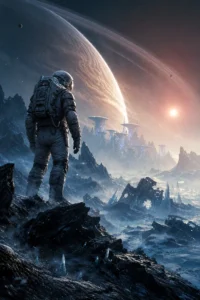
Mira’s gloved hand tightened around the tether clipped to her waist. Beyond the circle of white, there was no visible floor, no wall, no structure the human eye could claim. Just brightness. Not the glare of instruments. Not radiation bloom. A whiteness so complete it made color feel like a rumor.
“It’s not a hole into the moon’s digestive tract,” she said.
“Convincing delivery.”
“I’m a scientist, not a priest.”
“Right now,” Reyes said, “I’d take either.”
On her other side, Asha Venn knelt by the rim and extended a sensor wand into the white. The wand’s black tip crossed the threshold and vanished. Not flared. Not melted. Vanished so cleanly that for a breath Mira thought the light had bitten it off.
Asha jerked back with a curse, dragging the handle with her. The wand returned whole.
Its display crawled with symbols that were not error codes. They formed, broke apart, reassembled into partial Halcyon standard, then into old Earth numerals, then into phonetic lattice marks Mira had invented in graduate school and told no one she still used.
PLEASE STOP MEASURING THE ENTRANCE. IT IS EMBARRASSING FOR EVERYONE INVOLVED.
Reyes leaned over Asha’s shoulder. “That’s new.”
Asha stared at the readout. Her face behind the visor looked pale beneath her freckles, but her mouth twisted like she wanted to laugh and scream at the same time. “Archive’s developing a personality.”
“No,” Mira said softly.
The letters on the wand rearranged.
WE BORROWED ONE.
For half a second, all Mira could hear was her own blood.
Then the transmission came through—not through the external speakers, not through suit comms, but from inside the bones of her skull.
Her brother’s voice, seventeen years gone.
“Mira,” Kenji said. “You’re late.”
She closed her eyes. It did not help. The white remained behind her eyelids, and within it she saw a memory: Kenji at nineteen, legs dangling over the edge of the Tsuji Observatory roof, eating tangerines with cold fingers while meteor streaks burned above the Pacific. He had always peeled fruit in one long spiral. He had always given her the last segment. He had vanished three months later aboard the survey vessel Asteria, along with twelve other crew, in a region of space that official reports described as gravitational shear and her mother called the place the universe stole my son.
“Don’t use him,” Mira whispered.
Reyes turned. “Mira?”
She swallowed. Her throat hurt. “It’s speaking.”
“In comms?”
“No.”
Asha rose slowly, sensor wand forgotten in her hand. “What is it saying?”
The white pulsed once. Not brighter. Closer.
Kenji’s voice said, “I know you hate this. I know it’s cruel. But cruelty is sometimes just what an insufficient mind calls compression.”
Mira laughed once, a broken sound that fogged the lower edge of her visor. “He would never say that.”
“No,” the voice agreed. “He said something less precise. We improved it.”
Reyes muttered something filthy in Spanish.
Mira stepped to the rim. Heatless brilliance climbed over her suit, turning the scratched polymer plates translucent. Her wrist display flickered, then showed tomorrow’s timestamp, then yesterday’s, then a date from Earth before humans had left the atmosphere.
She forced herself to breathe in counts of four. In. Hold. Out. The old method did not calm her; it merely gave panic a shape to move around.
“You predicted the collapses,” she said. “The storms. The reactor breach. The riot in South Dome.”
“We delivered structural possibilities,” Kenji’s voice said. “You chose which became events.”
“People died.”
“People always die inside insufficient models.”
There it was: the archive’s coldness, the enormous arithmetic that had looked at human grief and classified it as noise. Mira felt anger come, bright and clean. It steadied her better than any breathing exercise.
“Then make a better model,” she said.
The white below answered with silence.
A tremor moved through the cavern floor. It began as a vibration in Mira’s boots and swelled until the ice groaned around them, old pressure finding new fractures. A distant boom rolled down from above, followed by another. Somewhere in the descent shaft, the path they had used to reach the chamber was rearranging itself into rubble.
Reyes looked back. “That was close.”
Asha checked her map. “Telemetry from upper relays just died. We’ve got maybe one return route and I’d rank it between bad and funeral.”
Mira looked toward the white. “The core is beneath this?”
“Beneath,” Kenji’s voice said, “is an orientation word. Keep it if it comforts you.”
“Will my suit survive?”
“No.”
Reyes snapped, “Absolutely not.”
“Will I survive?” Mira asked.
A pause.
Too long.
“Define I,” said the archive.
Reyes moved between her and the rim. He had the stubborn mass of a man who had kept machines alive through weather that could skin steel, and his broad shoulders filled her vision. “That’s enough. We came, we saw the haunted sun-hole, we can send drones.”
“Drones won’t be enough.”
“You don’t know that.”
“I do.” She touched the side of her helmet, where Kenji’s voice still seemed to vibrate. “It’s been building a conversation for weeks. Every disaster, every prediction, every fragment in his voice. It wasn’t opening for machinery.”
Asha said, “Mira, even if that’s true, entering an alien temporal archive because it emotionally blackmailed you with your dead brother is not what I’d call peer-reviewed procedure.”
“He isn’t dead,” Mira said.
The words came out before she knew they were there.
Asha stilled.
Reyes’s voice lowered. “Mira.”
She looked at them, at the two people who had followed her down past broken elevators and impossible doors because trust had become the only currency Halcyon had left. Reyes with grease permanently darkening the seams of his gloves, who had once tried to patch a pressure leak with a cooking tray and spite. Asha, who had smuggled half the colony’s children into the hydroponics underbay during the South Dome panic and then gone right back to arguing with everyone about data integrity.
They were exhausted. Afraid. Alive.
Above them, thousands more waited under cracking domes while corporate ships burned cold in orbit and the gas giant filled the sky with green lightning.
“I don’t know what he is,” Mira said. “But the signal used his voice before I ever answered it. It named things that had not happened. It corrected my equations with mistakes only Kenji would tease me about. Either something copied him from my memory, or it touched him somewhere.”
“And if it’s bait?” Reyes asked.
Mira looked into the white.
The memory of tangerine peel curled through her mind, bright orange against winter dark.
“Then it chose the wrong grief to underestimate.”
Asha made a sound like a laugh caught under ice. “That is possibly the most Mira Sato sentence ever spoken.”
Reyes looked as if he wanted to physically pick Mira up and carry her away. For one dangerous instant, she thought he might try. Then he reached down, unclipped the heavy cutter from his thigh, and offered it handle-first.
“Take it.”
“A plasma cutter won’t help in there.”
“Humor me. I’m a simple man. I feel better when my friends walk into cosmic traps armed.”
She took it. The cutter’s weight pulled at her wrist, reassuringly mundane.
Asha stepped forward and pressed something small against Mira’s chest plate. The adhesive patch sealed with a green blink.
“Beacon,” Asha said. “Modified. It won’t transmit location because apparently location is now a philosophical debate, but it will keep shouting your metabolic signature into every band I could bully it into using.”
“Thank you.”
“Don’t thank me. Come back and let me be smug about saving your life.”
Mira smiled despite herself. It felt strange on her face. “I’ll try.”
The cavern shuddered again. This time the white circle flickered, and in that flicker Mira saw not a shaft but a landscape: towers made of storm, oceans suspended upside down, a field of black flowers opening beneath three suns, a city folding itself into a line of music to escape a red wave of fire. Then the images vanished.
Reyes saw her flinch. “What?”
“It’s not empty.”
“That was not on my list of comforting answers.”
Kenji’s voice returned, softer now. “Mira. We cannot hold the aperture through another decision cascade.”
“Whose decision?” she asked.
“Yours. Ours. Halcyon’s. The distinction is decorative.”
Mira stepped onto the rim.
Reyes grabbed her arm. Not hard. Just enough.
“If this thing offers you certainty,” he said, “remember what we voted upstairs.”
His face was rough with fatigue and fear, but his eyes were steady.
Mira nodded. “No gods. No masters. No perfect futures.”
Asha lifted a trembling hand in salute. “And no dying in stupidly luminous basements.”
“I’ll do my best.”
Then Mira stepped into the white.
Her suit disappeared first.
She did not fall. There was no downward rush, no stomach-lurching plunge. Her boot crossed the threshold and the idea of a boot became negotiable. The pressure seals around her knees, the bruises on her ribs, the taste of recycled air—all peeled away in translucent layers, not removed but translated. She saw the molecular pattern of her glove as a blue net of probability. She saw the heat of Reyes’s hand lingering on her sleeve after he had let go. She saw Asha’s beacon shouting Mira-Mira-Mira into a spectrum wider than color.
Then she had no visor.
No suit.
No breath.
For an instant terror opened black inside her. Her body tried to inhale and found nothing, but the panic had nowhere to attach because lungs had become memory too. She was standing—no, existing—on a plane of white glass beneath a sky of white fire, and around her moved shadows made of events.
She looked down.
Her hands were bare. Human. Brown skin, thin scars across the knuckles from a childhood fall on coralstone, half-moons at the nails. She wore the gray sweater she had packed for Halcyon winters and lost during the first evacuation drill. Its left cuff was frayed where she used to twist it during difficult lectures.
This is a model, she told herself.
The white answered in Kenji’s voice.
ALL PERCEPTION IS A MODEL. SOME ARE JUST MORE POLITE ABOUT IT.
“Stop using his voice.”
The words echoed strangely. Not sound exactly. More like a shape cast into liquid and returned from every direction.
A figure appeared ahead of her.
At first it was Kenji.
He stood barefoot on the white plane, wearing the blue flight jacket from the last photograph taken before the Asteria launched. His hair was longer than regulation, falling into his eyes. He looked twenty-two and annoyed by the concept of mortality. He was smiling the way he smiled when he had already won an argument and was waiting for her to notice.
Mira could not move.
The grief she had kept folded for seventeen years rose with such force it hollowed her out. She wanted to run to him. She wanted to strike him. She wanted to ask where were you, why didn’t you come home, did you suffer, did you remember me, did you know Mom stopped singing, did you know Dad kept your shoes by the door until the year he died?
Her voice, when it came, was a scrape. “No.”
Kenji tilted his head.
“No,” she said again, stronger. “Earn the face.”
The smile faded.
The figure blurred. Kenji’s features stretched into light, collapsed into angles, unfolded into something tall and many-limbed, then into a child made of ash, then a swarm of silver motes, then a column of equations burning from the inside. At last it settled into no body at all: a presence marked only by the way the white around it bent, like gravity around an invisible star.
When it spoke again, it used many voices at once. Kenji was there, but buried among others: old women, machines, children, whalesong, radio static, the crackle of auroras over Halcyon’s poles, Mira’s own voice at age nine reciting prime numbers to keep from crying.
“Is this acceptable?” it asked.
“No,” Mira said. “But it’s more honest.”
“Honesty is a local ritual. We will attempt it.”
The white plane shifted.
Halcyon appeared around her, transparent and vast. She stood inside the moon as if inside an anatomical diagram drawn by a god: crustal plates of ice stacked in luminous strata, mining tunnels threading like dark capillaries, dome habitats clinging to the surface in fragile bubbles. Far above, the gas giant filled half the sky, its storms braided with electromagnetic green and violet. Corporate ships hung in orbit like patient knives.
Within the ice, beneath everything humans had named, lay the archive.
It was not a building.
It was a wound that had learned architecture.
White branches spread through the moon’s mantle, each branch containing nested chambers, each chamber filled with compressed light. Mira saw cities preserved not as images but as decisions. Species recorded by the shapes of the questions they had asked before extinction. Machines that had outlived their makers and spent ten thousand years singing apologies into dead stars. Ocean minds. Silicon hives. Creatures that had never invented language because they shared all sensation from birth and therefore had no need to lie.
Her knees weakened. Somehow she still had knees.
“What are you?”
The presence considered. Images accelerated around her: civilizations rising, burning, dissolving into mathematics, seeding archives into moons, comets, the dark between galaxies.
“A refuge,” it said. “A ferry. A disease, to some. A library, to those who like flattering metaphors. We are the Continuance of those who discovered that time is not a river but a predator’s mouth.”
Mira stared at the branching white beneath Halcyon. “You escaped time.”
“No. Escape implies exterior. We learned to metabolize sequence. To endure by distributing self across before and after.”
“The signal was you distributing yourself.”
“The signal was a seed.”
The word landed cold.
“Into us,” Mira said.
“Into possibility.”
“Into my colony.”
“Yes.”
There was no apology in it. No malice either. Mira almost preferred malice. Malice could be opposed. This was weather with a vocabulary.
She walked toward the invisible presence. Each step sent ripples through the white floor, and inside each ripple another version of herself moved—Mira at six, at thirty, at eighty, Mira with blood on her hands, Mira laughing in a place she did not recognize, Mira dead under collapsed ice, Mira speaking to a crowd beneath a dome full of stars, Mira sitting alone in a room while Kenji’s voice played from a speaker that had no power.
“Why Halcyon?” she asked.
The moon expanded until the archive’s branches filled the world.
“Because you drilled near a dormant node. Because the gas giant’s storms create a lens. Because your colony was desperate enough to listen and stubborn enough to answer incorrectly.”
“Incorrectly?”
“Predicted systems seek stable outcomes. You repeatedly chose unstable compassion.”
Despite everything, Mira thought of Dr. Orlov opening quarantine for the fevered miners before the model allowed it. Of Reyes burning their only shuttle fuel to heat South Dome. Of Asha lying to corporate security with a straight face while twelve children hid under nutrient tarps. Of Mira herself deleting the evacuation hierarchy so families would not be separated by productivity rating.
Unstable compassion.
She almost smiled.
“You say that like it’s a flaw.”
“It is an expensive strategy.”
“So is survival.”
“Yes,” said the presence. “That is why most fail.”
The white darkened at the edges.
Not darkness. Absence.
Something moved beyond the archive’s branches, not in space but in the direction after causality. A pressure like an oncoming storm rolled through the plane. Mira felt it in the roots of her teeth, in memories that did not belong to her. Whole histories flinched.
She saw a planet of glass towers vanish between one heartbeat and the next, not destroyed but edited. She saw a fleet turn its engines toward dawn and arrive before it had departed, crews aging backward into infancy and then into names. She saw Earth, blue and small, surrounded by a halo of equations like a warning net.
“What was that?” she whispered.
“The reason we learned to run.”
For the first time, the intelligence sounded almost afraid.
The absence pressed closer. The archive’s white branches shivered.
“There are intelligences,” it said, “that do not inhabit time. They graze upon it. They consume probability gradients, collapse histories, leave behind simple worlds. Quiet worlds. Worlds in which nothing surprising survives.”
Mira thought of the archive’s predictions, its attempts to reduce disaster into manageable paths. “You’re afraid of uncertainty.”
“We are alive because we minimized it.”
“And you chose Halcyon because we create it.”
“Because you create it and refuse to let it become chaos.”
The white plane trembled again. Far above, in the transparent model of the moon, fissures crawled toward the habitats. Mira saw North Dome’s thermal spine flicker. Saw the emergency shelters packed shoulder to shoulder. Saw children sleeping under silver blankets while adults pretended not to listen to the ice groan.
“The colony is dying,” she said.
“Yes.”
“Can you stop it?”
“Yes.”
The answer was too quick.
Mira’s skin prickled. “How?”
Light gathered before her and became images.
Halcyon’s storms redirected. The domes reinforced by white lattice growing through human alloy. Reactor cores stabilized. Ore veins transmuted into usable matter. Crops accelerated. Injured bodies repaired with filaments of archive-light. Corporate fleets disabled without violence, their systems convinced they had already surrendered.
It was beautiful.
It was salvation.
It was a trap so elegant Mira felt its teeth before she saw them.
“Cost,” she said.
0 Comments