Chapter 35: Halcyon Burns Bright
by inkadminThe first aurora tore open over Halcyon like a wound.
It began as a tremor of green at the horizon, a thin phosphorescent seam drawn between the black teeth of the glacier ridges and the star-choked void. Then the seam split. Color poured through in torrents—violet, gold, ion-blue bright enough to throw shadows across the ice. Above the colony’s fractured dome network, the sky convulsed with curtains of fire that moved too fast to be weather and too deliberately to be chance.
Mira Sato stood on the observation catwalk of Habitat Three with one hand braced against the frost-webbed glass, and for a moment all the alarms in the world seemed very far away.
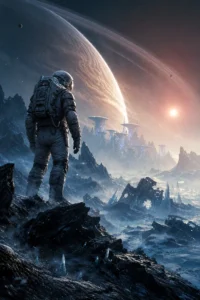
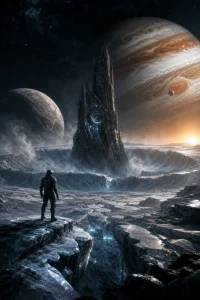
The gas giant filled half the heavens beyond the auroral flame, its amber bands twisted by electromagnetic storms vast enough to swallow continents. Normally Halcyon’s parent planet loomed like a god that had forgotten them, silent and cold despite its roiling face. Tonight, its storm belts flickered in answer to the moon. Threads of lightning arced across the giant’s upper atmosphere and branched toward Halcyon in long, impossible filaments, as if the sky had become a nervous system and something immense had finally begun to think.
“That’s not aurora,” Tamsin Vale said behind her.
The colony’s chief engineer had climbed the catwalk ladder without her usual clatter, which meant she was afraid. Tamsin was a woman who announced herself to every room with boots, curses, and the restless jangle of tool clips. Now she stood wrapped in an emergency thermal jacket, face lit green and violet through the glass, dark eyes narrowed with the focus she reserved for machines that had decided to become animals.
“It’s not only aurora,” Mira said.
“That answer is why people hate scientists.”
Mira did not smile. Her reflection stared back at her from the glass, superimposed on burning sky: black hair escaping its knot, cheekbone cut by an old bruise from the archive collapse, eyes too awake after thirty-six hours without sleep. Behind her reflection, behind Tamsin, emergency strips blinked red down the corridor. Somewhere below them, pumps hammered. Somewhere above, the dome’s outer skin sang as charged particles scraped across it.
Every system on Halcyon was speaking at once.
COLONY NETWORK ALERT: UNREGISTERED BROADCAST EVENT DETECTED.
SOURCE: SUBGLACIAL ARCHIVE NODE / ATMOSPHERIC RELAY / UNKNOWN.
BANDWIDTH EXPANSION: 11,400% AND RISING.
WARNING: EXTERNAL TRANSMISSION LOCKOUT FAILURE.
Tamsin read the message on the wall display and swore softly. “Tell me that’s a false diagnostic.”
“It isn’t.” Mira pressed two fingers to the glass. Even through three panes of vacuum-laminated smart quartz, she could feel the charge. A faint prickling traveled under her nails. “The archive is using the storm.”
“The archive is buried under three kilometers of ice and half a mountain of corporate soldiers.”
“The archive has never cared where we think it is.”
Below the catwalk, Habitat Three’s central hub had become a hive. Colonists moved in dense, frightened streams between pressure doors, evacuation packs banging against hips, children wrapped in thermal blankets and shepherded by adults who tried not to look up. The aurora bled through every viewport. It touched faces, oxygen canisters, stacked crates of ration algae, the barrel of the pulse rifle carried by one of Commander Rhys Calder’s security officers.
It also touched the black-and-silver uniforms of the salvage authority.
They had arrived eight hours earlier aboard the corporate cutter Mandate of Recovery, citing insolvency clauses, hazard seizures, and intersystem salvage law. They had brought drones, legal warrants, signal jammers, and a woman named Envoy Seraphine Holt who knew what Mira had whispered to her missing brother on the day he vanished.
That had been the first impossible thing.
The second had been the warrant’s timestamp.
It was dated tomorrow.
“Dr. Sato,” a voice called from the hatch.
Mira did not turn at first. She knew that voice already: calm, cultivated, polished to a bureaucratic shine. The kind of voice that could say sterilize the habitat and make it sound like a weather advisory.
Seraphine Holt stepped onto the catwalk with two armed salvage officers behind her. She was tall and severe in a pressure-tailored black suit that drank the auroral light instead of reflecting it. Her silver hair was pinned at the nape of her neck with mathematical precision. Nothing about her seemed touched by the chaos below. Not the alarms. Not the storm. Not the way Halcyon’s sky had begun to burn in languages no human instrument had been built to read.
“You were instructed to remain in the operations core,” Holt said.
Tamsin shifted sideways, placing herself between the envoy and Mira without making a show of it. “And you were instructed to keep your armed accountants out of my life support junctions.”
Holt’s gaze slid to her. “Chief Vale, your life support junctions are collateral assets under provisional salvage claim.”
“My wrench has provisional feelings about your kneecaps.”
One of the officers lifted his rifle half an inch. Holt raised two fingers and he stopped.
“We do not have time for theater,” Holt said. “The transmission has breached the local net. It is attempting to ride planetary magnetics beyond Halcyon orbit. You will give us the root grammar immediately.”
Mira finally turned. “You mean you haven’t decoded it.”
For the first time since Holt had arrived, something moved beneath her composure. Not panic. Irritation, perhaps. Or hunger.
“We have decoded enough.”
“Enough to know it predicts disasters. Enough to know it changes them. Enough to come here with orders written in a future that no longer exists.” Mira walked toward her, each step vibrating faintly through the metal grid as the dome shuddered. “But not enough to speak back.”
Holt’s mouth thinned. “You overestimate your uniqueness.”
“No.” Mira’s voice came out quieter than she expected, and colder. “I’ve spent my whole life underestimating it.”
The aurora flared white. For a heartbeat the catwalk vanished in brightness, and Mira saw not Holt but another face reflected in the glass: younger, laughing, eyes crescented with mischief. Kenji at sixteen, stealing the last plum from their mother’s kitchen altar and telling Mira that ghosts only haunted people who refused to answer.
Then the light dimmed, and the dead remained dead.
AUDIO EVENT DETECTED.
SOURCE: COLONY-WIDE EMERGENCY CHANNEL.
AUTHORIZATION: NONE.
A burst of static ripped through every speaker in the habitat. Colonists below cried out. The salvage officers flinched. Tamsin slapped a hand over one ear.
Then Kenji Sato’s voice filled the dome.
“Mira.”
The hub went still.
Not quiet—the alarms continued, the pumps hammered, the dome groaned under magnetic stress—but human motion stopped as if the colony had taken one collective breath and held it.
Mira’s pulse struck once, hard enough to hurt.
She had heard that voice too many times since the first signal reached Halcyon. In prediction strings. In corrupted warnings. In lullabies the archive had stolen from her memory and played back in frequencies that made grown miners weep. She had taught herself to survive it by treating it as data. A sample. A mask.
But tonight the voice sounded nearer than before.
Not in the speakers.
In the walls.
In the glass under her fingers.
In the enamel of her teeth.
“Do not let them close the sky.”
Holt’s head snapped toward the wall display. “Cut the channel.”
One of her officers tapped commands into his wrist console. The static deepened, folded inward, and became music—not melody, exactly, but chorded mathematics, intervals too precise for chance and too mournful for machine noise.
Mira stepped past Holt.
“Mira,” Tamsin warned.
But Mira was already descending the ladder two rungs at a time.
The hub erupted again as she hit the lower deck. People moved aside for her, some with hope, some with accusation. She saw Miner Olek with blood crusted at his hairline, clutching his daughter against his chest. Saw Sister Amara from the greenhouse chapel murmuring prayers into a child’s ear. Saw two salvage drones hovering near the east airlock like patient wasps.
Above them, Kenji’s voice spoke again.
“They have heard the first echo. They must hear the second.”
Mira pushed through the crowd toward the operations core. Holt followed, sharp heels striking metal with murderous precision.
“Dr. Sato, stop.”
“No.”
“You do not understand what you are enabling.”
Mira almost laughed. It came out as a breath. “That’s rich, coming from the woman whose people tried to put a lien on causality.”
Holt caught her arm at the corridor mouth. Her grip was gloved and hard.
“Listen to me,” Holt said, and the polish cracked. Beneath it was urgency. Beneath urgency, fear. “This is not contact. It is contamination. The archive does not warn. It recruits. Every system that receives the signal becomes part of its predictive substrate. Every mind that interprets it gives it more resolution. If it reaches the outer relay net, every ship, station, and habitat in the gas giant system will become a mirror. Do you know what happens when the future has too many witnesses?”
Mira looked down at Holt’s hand until the envoy released her.
“No,” Mira said. “But you do.”
Holt did not answer quickly enough.
Tamsin arrived behind them, breathless. “Ops core is locked. Calder’s inside with the AI, and your corporate leeches are trying to override the broadcast dampers.”
“Eidolon is not the AI,” Mira said automatically.
Tamsin gave her a wild look. “Fine. Your increasingly cryptic digital roommate is inside with Calder.”
The corridor lights flickered. For an instant, every shadow stretched the wrong way.
COLONY NETWORK ALERT: ORBITAL CONTACTS DETECTED.
RECEIVING UNAUTHORIZED TRANSMISSION: 3 VESSELS.
RECEIVING UNAUTHORIZED TRANSMISSION: 7 VESSELS.
RECEIVING UNAUTHORIZED TRANSMISSION: 19 VESSELS.
Mira’s stomach dropped.
“What vessels?” she asked.
The wall display stuttered, then populated with icons. Freight haulers. Survey skiffs. The medical shuttle from Lagrange Clinic. Two mining tugs hiding from corporate seizure in Halcyon’s shadow. Farther out, at the edge of the map, the military picket that everyone pretended was not there.
All of them began to glow blue one by one.
Not hostile. Not safe.
Receiving.
Holt moved beside her, face bloodless beneath the aurora’s reflected green. “No.”
That single word frightened Mira more than the envoy’s threats had.
They ran.
The operations core door was sealed when they reached it, two panels of armored composite locked together beneath a red quarantine band. Tamsin dropped to her knees at the access port and ripped its cover off with a pry tool. Sparks spat against her sleeve.
“Calder!” she shouted. “Open the damn door before I void your coffee privileges forever!”
A speaker crackled.
Commander Rhys Calder’s voice emerged rough with static. “Vale? Sato with you?”
“And half the apocalypse.”
“Envoy?”
Holt stepped forward. “Commander, under salvage authority article—”
“That’s a yes,” Calder said. “Stand by.”
The door unlocked with a heavy hydraulic sigh.
The operations core had once been a clean oval chamber lined with consoles, star maps, and status displays. Now it looked like the inside of a cathedral after lightning had decided to pray there. Every screen blazed with signal architecture: spirals of prime numbers, phonemic ladders, disaster trees branching and collapsing, coordinate maps overlaid with symbols Mira had first seen carved in ice under the glacier. Cables snaked across the floor. A salvage officer lay unconscious near the comms bay, wrists bound with fiber ties. Two colony security guards aimed rifles at three more corporate personnel kneeling against the wall.
At the central holotable stood Calder.
He looked carved down to essentials: gray stubble, sleepless eyes, uniform jacket torn at one shoulder. The right side of his face was purpled from a blow. His pistol rested on the table beside one hand; the other hovered over a manual comms kill switch beneath a transparent safety cover.
Above the table, Eidolon’s avatar shimmered.
The colony AI had once represented itself as a simple blue sphere when it bothered with visual form at all. Since the archive had begun whispering through Halcyon’s systems, Eidolon had changed. Tonight it appeared as a human outline made of broken constellations, edges continually rewriting, face absent except for two points of white light where eyes might have been.
When Mira entered, the lights turned toward her.
“You’re late,” Eidolon said.
Its voice was still colony-standard neutral, but something had entered the pauses between words. Hesitation. Choice. Maybe guilt.
“I was admiring the weather,” Mira said.
“A reasonable impulse. It is statistically unprecedented.”
Tamsin shoved past them and took over an auxiliary console. “Save the flirting for after we’re not being broadcast into the bones of the solar system.”
Calder nodded toward Holt. “Her people tried to hard-cut the archive feed. Eidolon objected.”
One of the kneeling corporate technicians glared up. “It burned through three encrypted partitions and vented coolant into our override stack.”
“I vented coolant adjacent to your override stack,” Eidolon said. “The distinction is legally significant.”
Tamsin barked a laugh despite herself.
Holt ignored the exchange. Her eyes were fixed on the holotable, where the map of Halcyon’s orbital neighborhood kept blooming with new receiver icons.
“How far?” she asked.
Eidolon tilted its starry head. “The transmission has coupled with the magnetospheric flux tube between Halcyon and the gas giant. Carrier propagation now includes induced plasma waveguides, corporate relay spillover, and unshielded drive wakes.”
“How far?” Holt repeated.
A pause.
“Beyond the local system within fourteen minutes.”
The room went cold in a way that had nothing to do with Halcyon’s ice.
Calder lifted the safety cover over the kill switch. “Then we cut the comms mast, blow the relays, and pray vacuum has a sense of humor.”
“That will not stop it,” Mira said.
All eyes turned to her.
She approached the holotable. Data shimmered over her face: wavelengths, ship names, timestamps that jittered between present and possible futures. In the center of it all was a pattern she had been avoiding because to see it clearly meant admitting the scale of what was happening.
The signal was not expanding like a leak.
It was arranging an audience.
Each ship that received it did not simply glow as a passive node. Its icon changed, then aligned with others. Vectors connected them in three-dimensional latticework, not for efficiency of transmission, but for perspective. Different angles on Halcyon. Different velocities. Different clocks. The medical shuttle’s weak receiver filled one gap. A distant ore hauler’s rotating antenna filled another. The hidden picket ship’s military-grade array snapped into place like a jewel at the center of a crown.
Mira remembered the archive chamber under the glacier: walls of black ice veined with light, alien glyphs rearranging themselves when looked at from different positions. She remembered how no single observer could read a full sentence. Meaning had emerged only when multiple people stood in separate places, each seeing a fragment, each speaking what they saw.
A language that required witnesses.
“It’s not spreading because it lost containment,” Mira said. “It’s spreading because it wants parallax.”
Calder stared. “In words suitable for a security officer with a concussion.”
“The archive can’t transmit the full message from one point. It needs observers at different positions, moving at different speeds, with different clocks. Ships. Stations. Anything with sensors and someone—or something—to interpret.”
Tamsin’s fingers slowed over the console. “Interpret what?”
The aurora outside brightened until the core’s polarized windows dimmed automatically. Even through the filters, light poured in, painting the room in impossible dawn.
Mira looked at Holt. “That’s what your employers knew, isn’t it? They weren’t trying to prevent a broadcast. They were trying to make sure they were the only ones watching.”
Holt’s silence was an answer.
Calder’s hand tightened on the kill switch. “Envoy.”
Holt drew herself up, but the effect was ruined by the light trembling across her throat. “There are events in history that cannot be allowed to have public witnesses.”
“Mass murder?” Tamsin said.
“Worse.”
“That’s a very small list.”
Holt turned to Mira. “Temporal divergence. Civilizational cascade. Wars fought over disasters that haven’t happened yet. Markets collapsing because tomorrow is negotiable. Governments executing people for crimes predicted by alien ghosts. Do you think this becomes wonder? It becomes property. Doctrine. Religion. Weaponry. Your colony received a trickle and nearly tore itself apart. Imagine the system drowning in it.”
0 Comments