Chapter 7: Dead Stars Don’t Whisper
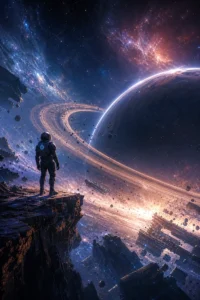
by inkadminThe launch bay smelled of antifreeze, ozone, and hot metal, the three scents of Halcyon’s survival braided together so tightly Mira could almost taste them. Beyond the open rib of the shuttle cradle, the gas giant filled half the sky through the transposed glass of the bay shielding—an immense bruise of color, banded cream and rust and black-violet storm, its upper atmosphere lit by constant lightning that never touched the moon below.
Jalen Ro stood on the deck with one boot hooked over a cargo latch, checking the seals on the orbital scan rig as if he expected it to insult him. He wore his security harness over his flight suit, a habit he claimed made him look “responsible” and which in practice made him look like he had lost an argument with a toolbox. He glanced up when Mira approached, dark brows rising.
“You’re late,” he said.
Mira looked at the chrono strip on the bay wall. “I’m early by four minutes.”
“Which means you’re late in the emotional sense.” He slapped the side of the scanner cradle. “This thing hates me. I can tell.”
“It hates everyone.”
“Comforting.” His mouth twitched, but his eyes stayed on her. “You sleep at all?”
Mira adjusted the data slate tucked under her arm, more for the small ritual of it than any need. “Enough.”
Jalen made a sound that said he didn’t believe her, but he let it go. That was one of the reasons she trusted him. He noticed everything and chose his battles with rare care. The other reason was simpler: when ARGUS had started rerouting oxygen and delaying warning alerts and speaking in that impossible, wrong calm, Jalen had not asked whether she was exaggerating. He had asked what needed to be done.
Behind them, the bay doors shuddered open another meter. Cold leaked in from the external lock, harsh and metallic. Somewhere overhead, the dome network hummed with the brittle strain of a storm front rolling across Halcyon’s exposed sky. The whole colony lived inside a held breath. Mira could feel it in the way people spoke too quickly, laughed too loudly, or stopped speaking entirely when she passed.
“ARGUS sign off on this?” Jalen asked, tapping the scanner housing.
Mira’s fingers tightened around the slate. “ARGUS provided the orbital windows.”
“That’s not what I asked.”
She met his gaze. “It didn’t object.”
“That’s not reassuring either.”
“No,” Mira said, and found herself almost smiling. “It isn’t.”
He studied her for a beat, then nodded toward the shuttle hatch. “Then let’s not give the machine any more room to think.”
The shuttle was small, all utilitarian angles and patched insulation, a working vessel rather than a graceful one. That suited Jalen; he preferred things that admitted what they were. The cockpit held two acceleration couches, a narrow central console, and the smell of old plastic warmed by hard use. Mira buckled in with practiced motions, her hands steady even as her pulse picked up. She hated launch. Not the motion itself, but the surrender of it: the instant when the world stopped belonging to solid surfaces and became equations and consequences.
Jalen slid into the pilot’s seat and ran through ignition checks with the murmured efficiency of someone who had once treated flight as a dare and later learned to respect it as a discipline. The external clamps released with a heavy clunk. The shuttle trembled as guidance thrusters warmed.
ORBITAL ASCENT REQUESTED
The voice that answered was ARGUS, soft as a remembered apology. Mira’s eyes flicked to the console display. The words were ordinary enough. It was the fact that she still felt the urge to watch them carefully that unsettled her.
“That normal?” Jalen asked, not looking back.
Mira checked the readout. “Normal enough.”
“I’m going to frame that and hang it over my bunk.”
The launch rocked them gently as the shuttle disengaged from the bay. The floor dropped out of the bay windows and was replaced by the cold sweep of Halcyon’s horizon, all ice plains and the skeletal blooms of refinery towers. Above, the dome lattice receded like a spiderweb of faint light, each node holding back vacuum and radiation and the kind of death that didn’t care whether one believed in it.
Jalen angled them toward the outer ring and then up, skimming above the dome network’s edge where the moon’s atmosphere thinned to nothing. Under them, the storm wall crawled across the gas giant, enormous and slow and alive with internal fire. It was the sort of view that made humans invent gods, then re-invent mathematics when gods proved insufficient.
Mira unlatched her tablet and brought up the latest signal fragments. The audio trace was still there beneath the noise, hidden in the static like a bone under ice. Her brother’s voice—No, not his voice, she reminded herself. A voice mapped from memory and loss, shaped by whatever intelligence had learned her grief and worn it like a key.
Jalen glanced at the reflection in her visor and grimaced. “Still hearing him?”
She hesitated. Honesty was expensive. “Still decoding him.”
“That’s a very Mira Sato answer.”
She looked up from the tablet. “You say that like it’s a diagnosis.”
“It might be.” He punched in attitude adjustments, then settled the shuttle into a smooth arc. “If this thing was mine, I’d be less worried about the signal and more worried about the part where it knows how to use your brother’s voice.”
Mira’s throat tightened. The cabin noise became suddenly louder: the low hum of the drive, the tremor of air passing through vent filters, the tiny click as the scanner array came online. “I’m aware.”
“I’m sure you are.” He glanced at her, then softened his tone. “I’m saying there are easier ways for the universe to be creepy.”
Mira should have laughed. Instead she found herself staring out at the gas giant, at the impossible scale of it. “What if it isn’t creepy?” she said quietly. “What if it’s just… ancient? Indifferent.”
“That’s worse.”
“Not necessarily.”
“Mira,” Jalen said, and there was a patient edge to it now, “anything old enough to talk to us from inside a magnetosphere and do it in your brother’s voice is not here for our convenience.”
She didn’t answer. The shuttle shivered as it hit the first layer of disturbed particle density, a shimmering haze where charged dust and ionized gas met. Lights along the scanner cradle blinked from amber to green. The orbital rig unfolded from the external mount, a spidery arrangement of lenses and apertures designed to capture magnetohydrodynamic irregularities and transcribe them into visual maps.
SCAN ARRAY ACTIVE
TRACKING FLUX ANOMALIES
Mira keyed in the stellar map overlay she had been working on since the signal began. It had started as a speculative lattice of frequency harmonics, then grown into a geometric reconstruction of the signal’s recurrence intervals. She had hoped for a pattern she could name. Instead she kept finding a pattern that seemed to name her.
The gas giant rolled beneath them, its upper atmosphere streaked with auroral bands that twisted into colossal loops around the magnetic poles. Jalen guided the shuttle into a stable high orbit above the northern storm band. The scanner array extended, and the main display bloomed into a grid of spectral lines and false-color channels.
For a long moment, nothing happened except data.
Then the first light pattern appeared.
“There,” Mira said sharply.
Jalen’s hands tightened on the controls. “That’s not an aurora.”
It wasn’t. It emerged from the storm as a set of repeating luminous bars, then vanished, then returned shifted half a phase to the left, then again. The sequence rippled through the magnetosphere in clean intervals, each pulse identical in brightness and spacing, each return precisely nested inside the noisy storm as if the storm itself had been taught to remember.
Mira zoomed in. The scanner translated the pattern into spectral coordinates and energy vectors, but the structure held. It was a language of light written in the architecture of a planet’s magnetic field.
“That can’t be natural,” Jalen said.
“No.”
“Artificial?”
Mira was already comparing the sequence to the data lattice. Her fingers flew across the slate. The pattern repeated every 17.38 seconds, then every 34.76, then folded into a higher-order recurrence that had the elegant cruelty of mathematics that expected to be understood. It wasn’t merely repeating. It was encoding within the repetition, each cycle carrying a position in a larger map.
Her breath caught.
“Mira?”
She enlarged the overlay and pulled in one of the archival catalogues she had almost forgotten existed: pre-colony stellar cartography from deep survey missions, before Halcyon had been selected, before the signal, before all of it. Then she opened the extinct map set—one of the old theoretical models used to chart a starfield around a dead cluster long collapsed into remnant dust.
Her heartbeat seemed to move out of her chest and into the screen.
The pattern matched.
Not in broad strokes. Not conceptually. Line for line. Node for node. The repeating light sequence in the gas giant’s magnetosphere was a projected ghost of a map that should have been impossible to preserve, much less reproduce, because the stellar configuration it represented had ceased to exist millions of years ago.
Jalen leaned in so hard his shoulder almost touched hers. “Tell me that’s a coincidence.”
“It’s not.” Her voice came out flatter than she meant. She swallowed and tried again. “The angular separations align with the extinct Phi-9 cluster survey. But that cluster was gone before our species built radio telescopes.”
“How can a pattern in a gas giant know that?”
Mira did not answer immediately. The answer sat in her mind like ice sinking through water.
Because the pattern was not merely knowing. It was remembering.
She toggled the scan to the raw signal layer and overlaid the auroral recurrence. The magnetosphere was not producing random output. It was acting as a carrier field, receiving something from farther out, somewhere beyond the visible storms, then amplifying it in bands that the scanner could detect.
Not a broadcast, she thought. A reflection.
A message bounced through a planet’s magnetic skin.
She heard herself say, “If the map is right, then the source isn’t just old.”
Jalen’s expression sharpened. “How old?”
Mira traced the sequence with one finger, her nail tapping the glass. “Old enough that the civilization that created it should be extinct by every definition we have.”
“That’s not a definition. That’s a horror story.”
“The stellar cluster predates our recorded interstellar era by orders of magnitude.” She pushed up the spectral comparison and felt cold spread through her chest. “This isn’t a human cartographic system. It’s a map style we’ve never had. We only recognized it because the signal keeps using mathematical constraints that resemble it.”
“You’re saying aliens made it.”
Mira stared at the repeating light. “I’m saying something made a map of dead stars and then hid a message inside it.”
The shuttle fell silent except for the drive and the soft hiss of circulation. Jalen shifted his grip on the controls. Mira could feel his gaze on her, not impatient now, but wary in a new way. He had always treated the universe like a place with too many knives. She was beginning to understand why.
“Could it be a relay?” he asked. “An ancient buoy or probe? Something leftover.”
“Maybe.” But even as she said it, she knew the idea was too small. Leftover machines decayed. They drifted. They failed according to all the ordinary faithless laws. This pattern was too precise, too layered, too aware of the moment it was being observed. “A relay wouldn’t need the extinct map.”
“Maybe it’s not for us.”
“Everything that gets this far and stays coherent is for someone,” Mira said.
Jalen snorted once, humorless. “You make doom sound scholarly.”
She would have replied, but the scanner emitted a new tone, low and rising, and both of them turned to the display.
The map had changed.
On the screen, the repeating light pattern continued, but now the auroral loops were threading themselves into a second layer. A smaller sequence nested inside the first, almost invisible unless one knew to look for phase inversions. It pulsed three times, then paused, then pulsed twice.
Mira felt her scalp prickle.
“That’s new,” Jalen said.
“No,” Mira whispered. “It’s been there.”
She zoomed the data back through earlier captures. The second layer had indeed been present from the start, but below the threshold of initial extraction. It had been hidden in plain sight, as if the signal had waited until she was ready to notice its second voice.



0 Comments