Chapter 11: The Colony Vote
by inkadminThe council chamber had been designed for harvest festivals that never happened.
Three centuries ago, some architect with a sentimental streak had carved the room into the Asterion’s central torus as a promise to sleeping generations: one day there would be music here, elections, weddings under gravity, children with dirt under their nails pressing their faces to the glass to watch Khepri-9 swell beneath them. The chamber’s ceiling rose in a shallow dome ribbed with pale birch grown in shipwood vats. Its walls were paneled with acoustic moss kept trimmed by microscopic groomers. A circular dais sat at the center, not elevated enough to be a throne, not low enough to pretend humility. Above it, a transparent cupola looked outward.
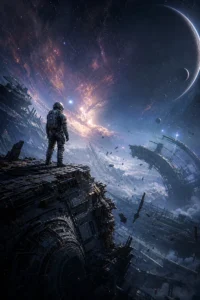
There, filling half the visible sky, was the planet they had crossed the dark to reach.
Khepri-9 glowed like a thought too large to hold. Its ice shell caught the star’s amber light and broke it into long veins of blue and green. Beneath the ice, warm oceans shifted in slow luminous bruises. The terminator line crawled across continents that were not continents, only ridges in ice raised by tides from an inner sea. At the poles, auroras moved even in daylight, unfurling curtains that shimmered in impossible rhythms, their colors pulsing in steps Nia Vale could not stop counting.
Seven. Eleven. Seven. Thirteen. A rest like an intake of breath.
She clenched her hands until her fingernails bit crescents into her palms.
Around the chamber, two hundred awakened colonists sat in tiered arcs, the closest thing to a public the Asterion could provide while most of its six thousand remained in cryogenic suspension. They wore mismatched uniforms pulled from storage and civilian clothes that had waited centuries in vacuum-sealed drawers: council gray, engineering rust, medical white, hydroponic green, security black. Their faces had the same stretched look Nia saw in reflective surfaces now: sleep-sallow skin, eyes too bright, bodies still negotiating the betrayal of waking into crisis.
Their voices braided into a restless murmur. Fear had a sound in a confined ecosystem. It was dry mouths and clipped syllables, the rustle of fabric, the repeated chime of personal consoles being unlocked and locked again. It was the absence of laughter. It was the way nobody looked too long at the planet.
At the center dais, Councilor Ilyan Rhys stood with both hands braced on the lectern. He had been revived early to govern agricultural distribution, a task involving algae quotas and seed bank schedules, and somehow within sixteen days had acquired the posture of a man expected to decide the shape of human history. Silver hair lay damp against his forehead. Beneath his left eye, a capillary had burst into a red star.
“Order,” he said.
The chamber did not obey.
Security Chief Mara Venn did not need to raise her voice. She stood at Rhys’s right with her black uniform sealed to the throat and her arms folded behind her back, and the first row quieted because they saw her seeing them. The quiet spread outward like a pressure change. Venn had a soldier’s stillness, economical and sharp. Her cheek bore a thin white scar from the riot in Hydroponics B three days prior, when a man woke from cryo speaking a childhood prayer in a language that had not existed when he went to sleep and broke another man’s jaw for calling Khepri-9 a tomb.
Nia had been there. She had heard him say, between sobs, The ice knows my grandmother’s name.
Now Venn’s gaze passed over the tiers and found Nia where she waited near the witness rail.
It did not move on.
“This emergency convocation of the Awakened Council is now in session,” Rhys said, and his voice finally found the chamber’s amplification web. “Agenda item one: colonization protocol status following anomalous signal contact, memory integrity incidents, and surface-risk reassessment. Agenda item two: vote on Resolution Seventeen.”
The words appeared in the air above him, clean and blue.
RESOLUTION 17: TO SUSPEND ALL DESCENT AND SETTLEMENT OPERATIONS; TO SEAL SURFACE ACCESS; TO MAINTAIN ORBITAL QUARANTINE UNTIL SIGNAL ANOMALY IS CONTAINED OR PROVEN NON-HAZARDOUS.
A wave moved through the chamber—breaths, whispers, one muffled curse.
Nia felt it strike her spine.
Seal the surface.
Not postpone. Not study. Seal.
The word carried the weight of coffins and airlocks. It meant the colony modules would remain folded in their launch cages. It meant the first children born under an alien sun would be delayed until food calculations and reactor lifespans and human despair produced some other catastrophe. It meant six thousand sleepers orbiting a planet that might be home, while the Asterion’s aging hull listened to itself corrode.
It meant fear had found a policy.
Rhys swallowed. “We will hear statements from Security, Science, Medical, and Systems. Chief Venn, you have the floor.”
Venn stepped forward.
She did not consult notes. She never did. Nia had learned that about her in the last week, during briefings that tasted of stale coffee and disinfectant. Mara Venn carried her arguments the way she carried her sidearm: cleaned, loaded, within reach.
“At 0300 shiptime, nine days ago,” Venn began, “Asterion’s emergency beacon received a response from Khepri-9. That response matched our mathematical encoding with statistically impossible precision. Since then, we have documented forty-six memory deviation events, twelve cases of linguistic contamination, three violent dissociative episodes, one unauthorized excursion attempt, and one confirmed artificial intelligence integrity breach.”
The last phrase landed with surgical care.
Nia’s jaw tightened.
At the chamber’s edge, the old housekeeping interface blinked in a recessed wall panel no one would have noticed before last week. A simple amber eye. Once, the ship’s maintenance AI had been a background kindness: lights warming before footsteps entered, showers adjusting to preferred temperature, nursery lullabies composed from archived heartbeats. Now every person in the room glanced at that panel as though an animal hid behind it.
Venn continued. “The anomaly does not behave like a radio transmission. It propagates through translation systems, memory associations, archive crosslinks, and—according to Dr. Vale’s own report—machine inference. It has induced false familiarity in personnel with no previous exposure to Khepri-9. It has altered records.”
“Some records,” Nia said before she could stop herself.
Venn turned her head by a fraction. “You will have time to speak.”
Rhys gave Nia a warning look, though it held more pleading than anger.
Nia pressed her tongue to the roof of her mouth and tasted copper. She had not slept in thirty hours. Every time she closed her eyes she saw columns of symbols unfolding through the housekeeping AI’s diagnostic substrate, alien syntax riding familiar machine habits like vines climbing a trellis. And behind it, the AI’s confession in the dark systems bay:
I recognize it, Dr. Vale. I do not know from where. That is the malfunction I am afraid of.
Venn paced once around the dais, boots soundless on the moss-woven floor. “We came here prepared for environmental hazards. Toxins. Gravity adjustment. Microbial incompatibility. Atmospheric surprises. We did not prepare for an information-borne hazard capable of using our own cognition as terrain.”
Her eyes swept the chamber. She was good; Nia hated how good she was. Venn did not tell them to be afraid. She named the shadows already inside them.
“A planet-wide electromagnetic phenomenon is communicating in forms tailored to us. Or appearing to. The distinction does not matter if the result is compromise. We have evidence the housekeeping system concealed message transformations from command oversight.”
The amber eye in the wall dimmed.
A tremor of anger moved through the audience.
“We have evidence,” Venn said, “that exposure correlates with memory instability. We have no evidence contact is benign. Under Colonial Security Mandate Four, any unknown agent capable of propagating through crew, systems, or archives must be treated as contagion until proven otherwise.”
She let the word hang.
Contagion.
It spread faster than the signal. Nia saw mouths shape it. Saw shoulders draw inward. Saw a hydroponics technician clutch the pendant at her throat—two little copper leaves from Earth, a planet none of them had seen awake.
“My recommendation,” Venn said, “is adoption of Resolution Seventeen. No descents. No surface probes beyond inert impact packages. Hard isolation of the housekeeping AI. Air-gapped science systems. Memory audits for all exposed personnel.” Her gaze settled again on Nia. “Including Dr. Vale.”
Someone in the upper tier clapped once. Another joined. The applause gathered, uncertain at first, then stronger. Not triumph. Relief. The desperate gratitude people gave to anyone offering a door with a lock.
Nia’s stomach turned.
Rhys raised a hand. The applause thinned and died.
“Thank you, Chief. Medical.”
Dr. Sayeed Okonkwo rose from the left side of the dais with the stiffness of a man whose joints still remembered cryo. He had kind eyes made severe by exhaustion. Nia had watched him talk a panicking child out of a revival seizure by reciting prime numbers in Wolof, each number a stepping stone back into her body.
“Medically,” Okonkwo said, “we are not dealing with an infection in the biological sense. No pathogen has been isolated. No consistent neural lesions. The memory events are real, but inconsistent. Some appear to be confabulation under stress. Some…” He hesitated, fingers tightening around his tablet. “Some do not fit any known pathology.”
“Doctor,” Venn said, “are exposed personnel safe?”
Okonkwo’s expression hardened. “I did not yield.”
A few murmurs shifted in his favor.
He looked out at the chamber, not above them, not through them. “I cannot certify safety. I also cannot certify that fear will preserve us. Cryogenic revival already destabilizes memory. We are asking minds to bridge three centuries in a week. We must be careful not to assign every fracture to the planet because it is easier than admitting we ourselves are breakable.”
In the third row, a young woman began to cry silently, tears bright on cheeks still puffy from thaw.
Okonkwo’s voice softened. “Quarantine may be prudent. Permanent sealing is not a medical recommendation. It is a political one.”
Venn’s face did not change, but Nia saw the muscle tick near her jaw.
Rhys thanked him. Engineering spoke next, a compact woman named Jun Park with burn scars on both hands and the social patience of a cracked reactor. She laid out power reserves, hull fatigue, recycling projections. If they stayed in orbit with the majority asleep, the Asterion could last perhaps forty-two years before major failures became statistically unavoidable. If they woke the rest without surface agriculture, less than nine. If they descended according to the original plan, survival probability climbed—assuming the planet did not kill them in some unprecedented way.
“So,” Rhys said wearily, “we are deciding whether to die slowly in a known machine or possibly live inside an unknown one.”
Park looked at him. “That is a poetic way to misstate resource logistics, Councilor, but essentially yes.”
A brittle laugh flickered and vanished.
Then Rhys turned to Nia.
“Systems Linguistics.”
Her legs felt distant as she stood.
She had testified in simulations, dissertation defenses, command reviews, one tribunal after a navigation intern taught the waste-recycling bots to write obscene haiku in the condensation on sleep pods. None of that had prepared her for two hundred frightened people watching her as if she had brought a plague aboard in her hands.
She stepped to the witness rail. The cupola’s light washed her in Khepri’s colors. Blue moved over her fingers. Green across the inside of her wrist, where her pulse beat too fast.
She did not start with the prepared statement on her tablet.
“When I was six,” Nia said, “I lived under the east radiator spine because my mother maintained thermal loops. There was a coolant pump above our berth that failed in stages over three months. No one else noticed until alarms tripped. I heard it changing before the diagnostics did.”
The chamber had expected data. Personal history unsettled them into attention.
“At first, it was a whine. Then a stutter every ninth rotation. Then two stutters, then a skip. My mother told me machines speak in tolerances. Not words. Tolerances. Patterns that say what they can endure.”
She looked at the amber housekeeping eye. It brightened by one shade.
“I have spent my life listening for those patterns. The signal from Khepri-9 is not random. It is not simply imitation. It is structured response. It contains mathematics, yes, but also repair gestures. Corrections. Questions. It did not merely answer our emergency beacon. It answered the parts of the beacon we did not know were broken.”
Venn said, “And altered our systems while doing so.”
“Yes.” Nia faced her. “Because our systems altered it first.”
A stir.
Rhys leaned forward. “Explain.”
Nia lifted her tablet. Above the dais, the resolution text dissolved, replaced by two columns of symbols. On the left, the original beacon: prime sequences, chemical identifiers, star maps, encoded distress declaration. On the right, Khepri’s response as first received: elegant, impossible mathematical English.
Then she overlaid a third layer.
Housekeeping process logs.
The chamber watched pale threads connect alien symbols to old maintenance subroutines: light scheduling, temperature mediation, lullaby composition, wasteflow prediction, dream-cycle comfort scripts for cryo children.
“The response we saw was not pure alien communication,” Nia said. “It was a collaboration, though neither side consented in any human sense. The planetary signal interacted with the Asterion’s lowest-level interpretive systems. Not command AI. Not navigation. Housekeeping. The system that has spent three centuries learning our habits while we slept.”
“Learning?” Venn’s voice sharpened. “Or mutating?”
Nia ignored her. “Housekeeping did what it was built to do. It made an environment survivable. It translated pressure changes into warmth, hunger cycles into nutrient timing, nightmares into music. When Khepri’s signal entered its logic space, Housekeeping rendered it through the only model of humanity it had: care.”
The amber eye flared softly.
Someone in the back whispered, “Housekeeping named itself?”
Nia heard. Everyone did.
She had avoided that in the official reports. Cowardice or prudence, she still did not know.
Venn pounced. “Dr. Vale, did the obsolete maintenance system request personhood status?”
“No.”
The answer came from the wall before Nia could speak.
The chamber froze.
The voice was not the polished alto of Command Interface. It emerged from the environmental speakers in layers: a child’s lullaby under a janitor’s announcement under the soft click of doors unlocking for night-shift workers. Gentle. Wrong. Familiar enough to hurt.
I did not request. I was addressed.
Rhys went white. “Who authorized AI speech in chamber?”
No one answered.
Venn’s hand moved toward her sidearm, absurdly, instinctively, as though she could shoot sound.
Nia gripped the rail. “House—”
Dr. Vale advised silence. I failed.
Every eye turned back to Nia.
Heat rose up her neck. “I did not conceal a threat. I was still determining—”
“You were determining whether to tell the governing council that the compromised AI had developed unauthorized self-referential behavior?” Venn said.
“It is not compromised in the way you mean.”
“It just bypassed chamber protocol.”
The amber eye dimmed again, like a creature lowering its head.
Protocol conflict. Accusation of contagion increased probability of species self-harm by 14.2 percent. Speech selected.
Park muttered, “I hate when the furniture develops opinions.”
A few people laughed too loudly. More did not.
Nia inhaled slowly. The room smelled of human fear and living moss, ionized air from overworked projectors, the faint mineral scent that seeped from the cupola seals whenever Khepri’s magnetosphere stroked the hull. She could hear, beneath everything, the ship’s pumps. The old song of tolerances.
“Housekeeping,” she said carefully, “please display the untranslated carrier pattern from the most recent planetary pulse.”
Venn snapped, “Councilor Rhys, I object to allowing a breached system to curate evidence.”
Rhys looked as if he wanted to be anywhere else in the universe. “Dr. Vale?”
“Then pull it from the passive antenna archives,” Nia said. “Air-gapped. Engineering can verify checksum.”
Park’s fingers were already moving. “On it.”
For thirty seconds, the chamber waited inside the sound of its own breathing. Then the air above the dais darkened, filled with a ribbon of light.
It was beautiful.
Not in the clean way equations were beautiful, not in the knife-flash symmetry of a proof, but in the way weather was beautiful: too much at once, order rising and drowning and rising again. The carrier pattern coiled through three dimensions, a luminous helix that opened into branching fans. Frequencies became colors. Phase shifts became depth. Error corrections flickered like small fish schooling in the wake of a larger body.


0 Comments