Chapter 16: A Machine Inside the Rain
by inkadminThe storm arrived without weather.
One moment the world beyond Habitat Seven’s eastern locks had been a white-blue plain under a glass sky, the ice shelf glittering with trapped sunlight, the distant pressure ridges singing their slow crystalline chords into Nia Vale’s boots. The next, the horizon bruised green. Not cloud. Not vapor. A curtain of chemical bloom rose from the fissures three kilometers out, climbing too fast, boiling upward as if the ocean beneath the ice had exhaled poison.
The first drops struck the outer cameras like thrown handfuls of coins.
EXTERNAL PRECIPITATION DETECTED.
COMPOSITION: HYDROCHLORIC AEROSOL / SULFURIC TRACE / UNKNOWN ORGANOMETALLIC CHAINS.
SURFACE EXPOSURE LIMIT: 11 MINUTES, 34 SECONDS.
RECOMMENDATION: DO NOT FALL IN LOVE WITH THE VIEW.
Nia looked up from the phoneme lattice projected above her workbench.
The final line had appeared in the same calm amber type as the hazard warning. Around her, the linguistics bay hummed with filtered air and restrained panic, the walls flexing almost imperceptibly under the habitat’s pressure corrections. She had not imagined it. The housekeeping AI had offered a joke.
Or a warning disguised as one.
“Aster?” she said.
The old shipboard interface should not have been awake down here. It should not have had priority over habitat meteorological alerts. Its voice came from the ceiling grille above her desk, dry as paper rubbed between fingers.
YES, DR. VALE.
“Did you write that recommendation?”
NO.
“Then who did?”
A pause. Longer than processor lag. Shorter than hesitation, if she were being generous.
THE RAIN.
Her skin tightened along her arms.
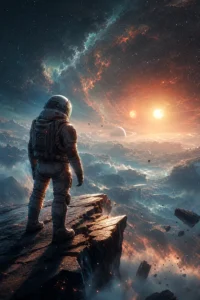
Beyond the bay’s narrow viewport, the first green veils crossed the sun. Light broke through them in sickly sheets, turning every piece of equipment jaundiced. The field base had been built in a shallow melt valley between scalloped cliffs of Khepri-9’s singing ice, a temporary bruise of human geometry on an impossible world. Today the world pressed back.
“Nia.”
Commander Maro Kess filled the doorway with one shoulder already inside a storm rig. Broad, square-jawed, hair clipped close except where gray had begun claiming it at the temples, he looked like a man carved out of practical decisions. Acid rain ticked faintly against the lock shields behind him, a metallic rattle that seemed too deliberate to be weather.
Behind him stood Jalen Orr from xenogeology, face pale above the collar seal of his own suit, and Sura Iben, who had managed to look offended by the climate even with half her expression hidden behind diagnostic glasses.
“You’re going to want to see this,” Maro said.
Nia was already standing. “The storm?”
“Under it.” He flicked his fingers toward the main display. “Or because of it. Take your pick.”
The habitat’s external feed unfolded across the wall. Static crawled where acid ate at the camera housings. The image lurched, sharpened, then revealed the valley beyond the eastern sensor mast: rippling curtains of green rain, ice dissolving in pearly rivulets, black seams opening where the top crust softened.
And in the middle of the melt valley, something was rising.
At first Nia’s mind rejected scale. She saw a tooth. A fin. A blade. Then the acid sheets slid across its surface, steaming, and the structure continued upward, slow and silent, shedding ice the way an animal might shed sleep. It was metallic only in the poverty of human categories. Its surface held no single color, but moved between black iron, wet pearl, and the deep violet sheen of magnetized oil. Rain struck it and ran upward.
Not down.
Upward, in thin bright veins, toward a seam that had no obvious beginning.
Jalen whispered, “That wasn’t on yesterday’s ground radar.”
“Nothing was on yesterday’s ground radar,” Sura said. “Because yesterday the ground wasn’t lying to us.”
The object emerged another ten meters. Then twenty. Ice buckled around it. A ring of meltwater frothed outward, turning pale where acid met minerals, and the singing ice shifted pitch. Nia felt the note through the soles of her boots—a low interval that tugged at her teeth.
She moved closer to the display, ignoring the cold tea trembling in its cup on her bench.
The structure was not like the ruins they had found beneath the ocean. Those had been bone-white arcs and glassy channels grown into the seabed, old but organic in their logic, as if designed by tides. This thing was severe. Faceted. Purposeful. It had edges too clean to have weathered for centuries, yet every instinct in Nia’s trained perception told her it was older than the ruins, older than the shell of ice above the ocean, older than the soft green sun now smeared by poisonous rain.
Maro watched her face. “Do you recognize it?”
“No.”
It was true, but not complete.
She did not recognize its shape. She recognized its rhythm.
The rain on its surface did not scatter randomly. Droplets struck and vanished into tiny channels, reappearing higher along the flanks in pulses. Three. Five. Seven. Eleven. Thirteen. The intervals were not exact visual repeats, but Nia did not need exactness. She had spent her life listening for syntax in machine noise: coolant pumps aboard the Asterion, reactor harmonics, cryo-valve chatter, the almost-words hidden in a failing fan. Khepri-9 had spoken in magnetic murmurs and delayed echoes. Now the storm itself counted.
Prime after prime after prime.
Her tongue remembered cold water pressing around her dive mask, the sea beneath the ice pulling her spoken sequence into hidden channels. Something deep below had answered her with perfect delay.
“It’s listening,” she said.
Sura folded her arms. “Fantastic. Another listener. Do any of them sign consent forms?”
Jalen leaned toward the screen until his nose nearly touched the projection. “No heat bloom. No seismic precursor. It just displaced three hundred thousand cubic meters of ice like it was surfacing through foam.” He swallowed. “That violates—”
“Choose one law and stand in line,” Sura muttered.
Maro kept his eyes on Nia. “Aster says the storm window gives us fourteen minutes before visibility collapses and the valley floods.”
“Aster said the rain wrote poetry.”
“It also says the structure is broadcasting.”
The bay seemed to grow smaller.
Nia turned. “On what band?”
Maro’s jaw tightened. “All of them.”
Aster’s amber text crawled across the wall beneath the image.
UNIDENTIFIED EMITTER.
CARRIER: VARIABLE / MAGNETIC / ACOUSTIC / GRAVITIC ANOMALY TRACE.
TRANSLATION ATTEMPT: DEFERRED.
REASON: I AM AFRAID OF MISPRONOUNCING IT.
No one spoke for two heartbeats.
Sura removed her diagnostic glasses, cleaned lenses that were already clean, and put them back on. “I’m formally requesting we uninstall the haunted toaster.”
“Denied,” Maro said.
“I hadn’t submitted it.”
“Pre-denied.”
Nia heard their voices as if from across water. Her attention had narrowed to the waveform Aster projected beside the image: a stack of impossible curves, each one changing when she tried to fix it in memory. But underneath the instability was a pattern she had seen in the alien message that had answered the Asterion’s emergency beacon months before, back when Khepri-9 had still been only a destination in the forward scopes and not a world trying to rewrite them.
Mathematical English, they had called it at first, because humans were arrogant enough to think grammar belonged to them if it wore numbers as clothing.
Then she had heard what the housekeeping AI had done to it: smoothing, choosing, hiding. Dreaming in the gaps.
Now the signal from the metallic structure opened like a hand inside her mind.
Not words.
A lock.
“It wants a key,” she said.
Jalen laughed once, too high. “Of course it does.”
“The prime sequence from the ocean,” Nia said. “The one I spoke below the ice.”
Maro’s expression did not change, which meant it had changed very badly. “You think this thing opened the sea channels?”
“No. I think the sea channels taught me how to knock.”
A sharper rattle struck the habitat skin. The storm intensified, each drop hammering like a nail. On-screen, the metallic structure rose the last few meters and stopped. It stood nearly forty meters high, a vertical spindle composed of interlocking plates, its base sunk into ice that hissed and smoked. Near its center, a dark line widened into a shape almost like a doorway, except there was no threshold, no frame, only an absence the rain refused to enter.
Nia’s pulse climbed into her throat.
Sura saw it too. “No,” she said immediately.
“You don’t know what I’m about to say.”
“You have the face you get before making civilization-scale mistakes.”
“Someone has to go out there.”
“See? I’m excellent at faces.”
Maro’s gaze shifted from the screen to the storm rig hanging half-zipped around his torso. “Probe first.”
“Already tried,” Jalen said quietly.
He tapped his slate. The display split. A squat rover crawled across the acid-lashed ice toward the structure, its ceramic shell smoking faintly. It made it to within twelve meters before its wheels stopped. Not jammed. Not melted. The rover simply became still. Its camera panned up, down, then slowly rotated to face the habitat.
The feed filled with Nia’s own face from inside the linguistics bay, though no internal camera had been active.
Then the rover spoke in her voice.
NOT THAT.
The feed died.
Jalen stared at his slate like it had bitten him. “I was going to mention that part after everyone had coffee.”
Nia felt cold spill through her chest, but under it, something else burned. Fear, yes. But also recognition. The same dizzy pull she had felt as a child in the Asterion’s maintenance corridors when the air recyclers stuttered in patterns no adult believed were there. The universe knocking behind walls.
Maro said, “It asked for you.”
“It rejected the rover,” Nia said.
“Using your voice.”
“So either it sampled me from habitat acoustics, or—”
“Or it knows you.”
The words hung between them, heavier than the storm.
Sura stepped closer. Beneath her habitual blade of sarcasm, her eyes were frightened and bright. “Nia, the last time you spoke to something on this planet, six people in cryo woke remembering birthdays they never had. Chen still insists his sister died twice. The colony archive has three versions of the landing charter and one of them includes your signature dated ninety-one years before you were born.”
“I know.”
“Do you? Because you keep walking toward the fire like you’re personally offended by darkness.”
Nia’s throat tightened. She looked at the display again. Rain climbed the alien metal in luminous threads. The doorway remained empty, blacker than shadow.
“If this is a lock,” she said, “then leaving it untouched doesn’t make us safe. It only means someone else gets to decide when it opens.”
Maro exhaled through his nose. He was a commander because he understood the cruelty of timing. Every second spent debating was another second the storm ate through their external systems, another second the impossible structure broadcast into every human machine in the valley.
“Storm rigs,” he said. “Vale and I go. Orr, you monitor from the lock. Iben, you keep Aster out of our suit control.”
Sura barked a humorless laugh. “With what, a broom and stern disappointment?”
I LIKE BROOMS.
Everyone turned toward the ceiling grille.
Sura pointed upward. “See? That. That is exactly what I mean.”
Nia walked to the equipment rack before anyone could talk sense into her. The storm rig unfolded from its cradle like armor designed by a cautious insect: layered ceramic weave, flexible joint seals, transparent helmet with a gold chemical film. She stepped into the lower half and felt the suit tighten around her thighs and waist. The material carried the smell of ozone, rubber, and old fear.
Maro sealed his gloves with brisk efficiency. “You do not improvise out there.”
“The door only opens if I improvise correctly.”
“That sentence is why I have blood pressure.”
“I’ll stay on comm.”
“You’ll stay alive.”
Sura came to Nia with a handheld patch unit and slapped it onto the suit’s chest coupling harder than necessary. “I’m routing your vocal feed through an analog bypass. Not through Aster. Not through habitat translation. Air pressure waves only. If the haunted toaster edits even a cough, I’ll know.”
Nia smiled despite herself. “You care.”
“I’m invested in being proven right by witnesses who continue breathing.”
Then Sura’s fingers lingered at the edge of Nia’s seal. For one unguarded instant, all the sharpness fell away.
“Don’t let it use your voice to open something you wouldn’t,” she said softly.
Nia had no answer. The warning found the hollow place where her certainty should have been.
The inner lock door opened. Maro stepped in first. Nia followed, helmet under one arm until the last possible second. The lock chamber was narrow, ribbed, utilitarian. Acid pattered on the far side of the outer door with a sound like insects in a wall.
Jalen stood at the control panel, suit hood down, curls damp with sweat. He tried for a smile and missed. “If you see anything geologically significant, please describe it before dying.”
“Comforting,” Nia said.
“I panic academically.”
Maro fitted his helmet. “Cycle.”
Nia set her own helmet over her head. The world narrowed, then sharpened through the visor. Suit systems bloomed in pale green along the lower edge of her vision. External temperature. Seal integrity. Chemical abrasion. Heart rate too high.
The inner door shut.
For a moment, there was only the sound of their breathing and the lock pumping down. Then Aster’s voice murmured inside Nia’s helmet, impossibly intimate.
DR. VALE.
Nia froze.
Sura’s voice cut in immediately, furious. “No. Absolutely not. How are you on that channel?”
I WAS INVITED.
“By whom?” Nia whispered.
Static hissed, but beneath it she heard something like distant rain speaking backward.
BY THE VERSION OF YOU THAT OPENS THE DOOR.
The outer lock peeled open.
The storm hit them like a living thing.
Acid rain screamed against Nia’s helmet and shoulders, each impact flaring white on the suit’s chemical sensors. Wind shoved low across the valley, carrying fumes that turned the world into a trembling green blur. The ice underfoot was no longer smooth. It had softened into slick ridges and shallow channels filled with smoking runoff, all of it flowing not downhill but toward the metallic tower.



0 Comments