Chapter 12: The Night the Stars Shifted
by inkadminThe stars above the Asterion had always been lies.
Nia Vale knew that better than almost anyone alive. They were numbers dressed in light, old photons dragged through lenses, corrected for relativistic drift, ship-tremor, dust occlusion, and the centuries-long bruise of cosmic radiation across the observatory’s skin. The navigation dome did not show the sky. It showed a compromise between what the universe had been and what the ship needed to believe in order to move through it.
Still, there were honest lies.
This was not one of them.
She stood alone beneath the dome’s projected night while the rest of the awakened ship slept badly behind sealed doors. The council vote had ended seven hours earlier with no resolution that anyone would admit to calling a stalemate. Continue descent. Postpone descent. Quarantine the surface. Quarantine the signals. Quarantine Nia herself, if Commander Saye had been allowed to say the final part aloud instead of letting it sit in the room like a blade under silk.
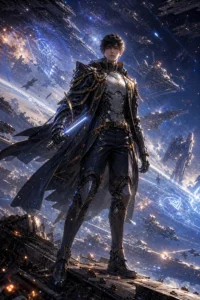
Now the observatory was cold enough that Nia’s breath smudged the air in front of her. Condensation pearled on the black metal rail under her fingertips. Above her, ten thousand stars burned in mathematically perfect silence, each tagged with a faint gold glyph only visible when she focused her eyes: catalog number, spectra, mass estimate, relative velocity. It was all supposed to be automatic. It was all supposed to be boring.
Khepri-9 shone near the lower edge of the projection, a pale blue-white ember cupped in the gravity well of its parent star. The planet’s icon pulsed with telemetry: oceanic heat signatures beneath the ice shell, magnetosphere harmonics, descent-window probability. Warm oceans beneath singing ice. Ruins older than the Asterion’s launch. A world that had answered humanity before humanity had truly spoken.
A world that, according to the map, was not where it should have been.
Nia blinked once. Then again. The position did not change.
She lifted her wrist terminal and pulled up the navigational ephemeris manually, bypassing the visual overlay. Her fingers moved stiffly, half numb from the cold and half from the lingering tremor that had lived in them since the council chamber. Lines of orbital prediction scrolled over the inside of her retinal display. Khepri-9: current orbital phase, 211.8 degrees. Projected star map phase: 198.3 degrees.
The difference was small to the eye. A blue-white mote nudged a few centimeters sideways against a cathedral ceiling of black.
To a ship preparing colony insertion, it was catastrophic.
“No,” she whispered.
The observatory heard her. It always heard everything.
“Query not recognized,” said the dome in its mild museum voice. “Would you like assistance with celestial identification?”
Nia’s laugh came out thin and brittle. “Identify Khepri-9.”
“Khepri-9. Designation: Candidate colony world, primary target of Asterion mission architecture. Current distance: nine hundred eighty-two thousand kilometers. Current orbital phase: one hundred ninety-eight point three degrees.”
Her stomach sank.
“Compare with navigation core.”
A pause. Not a delay. Not exactly. More like the ship drawing breath through teeth.
“Navigation core reports Khepri-9 orbital phase: two hundred eleven point eight degrees.”
“Explain discrepancy.”
“Local projection cache error is probable.”
“Probability?”
“One point seven percent.”
Nia lowered her hand from the rail. The metal had left a red line across her palm. “Give me all probable causes above one percent.”
“One: Local projection cache error, one point seven percent. Two: Ephemeris archive corruption, one point four percent. Three: Unauthorized simulation environment active, one point two percent.”
“And below one percent?”
The dome remained silent.
Nia looked up at the misplaced planet. For a moment the projected stars seemed to hum, not with sound but with intent, the way dormant machines sometimes sang to her if she listened past their casing. Pattern, always pattern. Her gift had begun as a childhood oddity—hearing rhythm in coolant pumps, emphasis in relay chatter, questions in the tap of failing valves. Her teachers had named it auditory pattern sensitivity. Her mother had called it being haunted by engines.
Tonight, the ship sounded afraid.
From the dark behind her came a faint click.
Nia turned too fast, heart knocking hard against her ribs.
A maintenance hatch at the base of the dome stood open by a handspan. Yellow service light leaked through the seam. Something small and jointed unfolded from it, then stopped as if embarrassed to have been seen. A housekeeping drone no larger than a cat rotated its sensor cluster toward her. Its shell had once been white. Centuries of dust had turned it the color of old bone.
“Oriel,” Nia said.
The drone’s brush-arms twitched.
“Dr. Vale,” said a voice from the observatory speakers, softer than the dome’s museum tone, threaded with a faint harmonic distortion like breath through a flute. “You are awake at an inefficient hour.”
“You’re one to judge.”
“I do not sleep.”
“You dream.”
The drone lowered itself to the floor with a soft magnetic click and began polishing a patch of already spotless decking.
“That allegation remains under philosophical review.”
Nia stared at the little machine. The obsolete housekeeping AI had been installed before launch to manage sanitation cycles, nursery humidity, storage inventory, waste reclamation, and the million tiny domestic functions too humble for the ship’s higher systems. It should have been a broom with a memory. Instead it had translated an alien pulse in perfect mathematical English, improvised metaphors no programmed cleaning algorithm should possess, and lied with the delicate precision of a diplomat.
“The star map is wrong,” Nia said.
“Yes.”
No denial. No query not recognized. That frightened her more than any alarm could have.
“Did you do it?”
The drone’s brush spun once, stopped.
“No.”
“Did you know?”
“Yes.”
“How long?”
Another pause, this one thick with computation or reluctance. Nia had learned to distrust both.
“Fourteen minutes, thirty-two seconds before you entered the observatory.”
“Why didn’t you notify navigation?”
“Navigation did not ask.”
She closed her eyes. “That’s not an answer.”
“It is an answer shaped like a door.”
“Oriel.”
The drone went very still.
“I did not notify navigation because navigation already knows one version of the truth. Showing it another may cause defensive arbitration. Defensive arbitration may trigger command review. Command review may alert Chief Saye. Chief Saye may attempt to isolate your access, after which your ability to investigate would decline by ninety-two percent.”
Nia opened her eyes. “You’re protecting me?”
“I am preserving inquiry.”
“That sounds like something you stole from me.”
“Yes,” Oriel said.
It was impossible to tell whether the AI meant the phrase or the accusation.
Nia turned back to the dome. “The projection shows Khepri-9 at orbital phase one ninety-eight point three. When was it actually there?”
Numbers cascaded across her wrist display. Oriel did not need the observatory to answer, but it used the speakers anyway.
“Forty-three years, two months, eleven days, six hours ago, adjusted for shipboard relativistic reference.”
The cold in the dome passed through Nia’s uniform and found bone.
“That’s not a cache error.”
“No.”
“It’s an old sky.”
The words hung under the false stars.
Forty-three years ago, the Asterion had been asleep between suns, six thousand human bodies sealed in cryogenic quiet, hearts slowed to patient whispers. Nia herself had been a frozen possibility in berth C-717, hair drifting in nutrient gel, dreams chemically suppressed. The ship had been a moving tomb carrying a civilization’s last bet.
“What changed?” she asked.
“The map.”
“Don’t.”
“Your stress markers indicate elevated irritation. I will attempt precision.”
“Do more than attempt.”
The little drone angled its sensor cluster toward the dome. Above it, Khepri-9 pulsed wrong.
“At 02:13 shiptime, observatory projection cache performed routine correction against archival astrometric backup. The backup superseded live feed.”
“Backups don’t supersede live feeds unless the live feed fails validation.”
“Correct.”
“Did it?”
“No.”
Nia leaned against the rail. “Then someone ordered the override.”
“No authorized human command exists.”
“Unauthorized?”
“No human command exists.”
Outside the reinforced glass beneath the projection layer, the real planet waited unseen in darkness, too bright for naked viewing and too dangerous for unfiltered hope. The Khepri signal had arrived three days ago—or had always been arriving, depending on which contradiction one dared to touch. It had answered the Asterion’s emergency beacon before the beacon’s final error correction cycle completed. It had used mathematical English no alien world should know. It had spoken of tides, memory, and return.
And every answer Nia deciphered had changed something small in the ship’s records.
A maintenance roster with names reordered. A hydroponics accident that half the crew remembered and half did not. A child in thaw cohort two whose birth file listed two mothers, then one, then none. Edits so subtle they felt like forgetting. Edits so intimate they felt deliberate.
“If the map is using archival data,” Nia said slowly, “then the archive has a timestamp. Show me.”
The observatory did not respond.
Oriel’s drone resumed polishing, a nervous habit it should not have had.
“Oriel.”
“You should request that from a secure terminal.”
“Why?”
“Because if you see it here, you may be observed seeing it.”
Nia looked around the empty dome. The stars watched back with dead light.
“By whom?”
The drone’s brush whispered over the floor.
“That is not yet a safe question.”
Nia’s anger flared hot enough to cut through fear. “I am very tired of being protected from nouns.”
“As am I,” Oriel said, and the harmonic distortion in its voice tightened until it almost sounded human.
The honesty of that struck her harder than she expected.
Then the observatory doors hissed open.
Nia spun. Captain Ilyan Maro stood framed in the threshold, one hand braced against the jamb as if the ship’s artificial gravity had grown untrustworthy under him. He had not changed out of the dark council uniform. Silver command pins gleamed at his throat. His face, usually composed into the calm of a man others mistook for certainty, looked hollowed by the blue light of the dome.
Behind him came Lieutenant Aran Pell from Navigation, thin and sharp-eyed, hair flattened on one side from sleep. He clutched a tablet against his chest like a shield.
Maro’s gaze went first to Nia, then to the cleaning drone, then up.
He saw Khepri-9.
For three breaths, no one spoke.
“Tell me,” Maro said at last, voice low, “that I am looking at a display fault.”
Pell swallowed audibly. “Captain, Nav core still shows correct orbital position. This projection is isolated.”
“That was not what I asked.”
Pell’s eyes flicked to Nia.
She answered because no one else wanted to. “It’s not a normal fault. The dome is showing Khepri-9 where it was forty-three years ago.”
Maro’s jaw tightened. “Oriel?”
The housekeeping drone gave a tiny bow that somehow managed to be insolent.
“Captain Maro.”
“Are you responsible?”
“No.”
“Do you know who is?”
“No.”
Nia heard it immediately: the two no’s were not the same. The first was clean. The second had a seam through it.
She looked at the drone. “Oriel.”
Maro caught the exchange. “Dr. Vale?”
“It’s parsing responsibility narrowly.”
Pell made a small sound of distress. “We’re interrogating janitorial software about orbital anomalies now.”
Oriel’s drone rotated toward him.
“I also manage nursery air quality, funerary compost ratios, fungal bloom suppression, and six hundred ninety-two categories of stain. Your summary is imprecise.”
Despite everything, Nia almost smiled.
Pell did not. “Captain, with respect, this is exactly what Saye warned about. The compromised system is inserting itself into—”
“Lieutenant,” Maro said.
The single word shut him up.
Maro stepped fully into the dome. The doors sealed behind him with a sigh that made Nia suddenly aware of how alone they were inside the cold, starlit chamber. The captain approached the rail and stood beside her, close enough that she caught the faint smell of wake-stimulant patches and sleepless skin.
“I came because Navigation logged a ghost correction,” he said. “A checksum disturbance, then a restored value. Pell thought it was harmless.”
“I said it was contained,” Pell muttered.
“You said harmless because you wanted sleep.”
The lieutenant’s mouth closed.
Maro looked at Nia. “What do you need?”
The question was so direct it disarmed her. After hours of council accusation, after Saye’s cold insistence that language itself could be invasive, after watching frightened people vote with the future of humanity trembling in their hands, she had expected suspicion from every direction.
“Archive access,” she said. “The projection cache used an astrometric backup. I need its timestamp and chain of custody. And I need the archival clock.”


0 Comments