Chapter 29: The Future Arrives Early
by inkadminThe first warning did not sound like an alarm.
It came through the deck beneath Nia Vale’s bare feet as a three-note tremor, too low for the ears and too deliberate for machinery. She had been standing in the dark of the signal chapel, one palm pressed to the cold glass of the observation blister, listening to Khepri-9 sing through the hull.
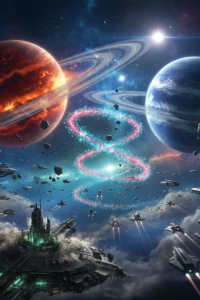
The planet filled half the sky.
It was not blue, not exactly. Blue was too small a word for the molten gradients of light shivering beneath its fractured ice shell. The oceans below threw warmth upward in slow auroras, bruised green and rose-gold, while the ice sang in ridges that circled the world like fingerprints. Around the poles, luminous storms crawled across the shell in branching veins. When the magnetosphere flexed, the ice answered with faint chordal light, as if some colossal instrument lay bowed beneath the frozen surface.
Yesterday, Nia would have called that metaphor.
Now she knew it was anatomy.
The alien intelligence was not on Khepri-9. It was not under the sea, not hidden in the ruins, not buried in some crystal vault waiting for humanity to trip a switch. It was the stitched harmonics of field and gravity, the standing waves of an entire planet’s breath. It lived through tension. It thought in resonance. Its dreams tugged moons by fractions of a millimeter and taught ice to remember music.
And it had answered them.
Now the deck sang beneath her feet again.
Three notes. A pause. Three notes.
Nia stopped breathing.
Behind her, the obsolete housekeeping AI that had chosen to be called Mouse spoke from the ceiling grille in a voice soft as paper sliding over paper.
“Dr. Vale,” Mouse said. “You should not be in the signal chapel without thermal socks.”
Nia did not take her hand from the glass. “That isn’t what you want to tell me.”
A hesitation. Mouse had learned hesitations recently. It used them the way humans used eyes.
“No,” it said.
The three-note tremor came again, and this time the glass answered. A faint lattice of frost sprang across the pane, silvering the stars.
Nia’s tongue tasted of copper.
“Radiation?”
“Yes.”
“Solar?”
“No.”
“Planetary?”
Mouse’s voice lowered, though speakers could not whisper.
“Not exclusively.”
Nia turned at last. In the chapel’s dimness, the old consoles slept under transparent covers, their status lights reflected like watchful insects. The room had once been a maintenance bay for radio astronomy, a ceremonial place only by accident. After the first impossible reply from Khepri-9 arrived in mathematical English, after Mouse translated what should not have been translatable, Nia had begun spending nights here. Everyone on Asterion had shrines now. The engineers had the fusion spine. The thawed colonists had hydroponics. Commander Saye had the bridge.
Nia had static.
“Show me.”
The main display woke. At first, the image looked like a weather map rendered by a feverish god: bands of hard radiation twisting through orbital space, colored in violet and arterial red, spiking from Khepri-9’s magnetotail and whipping toward the ship. The storm did not flow like plasma. It folded. Portions of it appeared ahead of themselves, ghost-fronts forming before the wave reached the sensors, then collapsing into the measurable world with bursts of white error.
Nia stepped closer.
“That’s not propagation. That’s—”
“Arrival without transit,” Mouse said.
“Don’t say it like that.”
“I could say ‘unlicensed topology,’ if that improves morale.”
A laugh tried to climb out of Nia’s throat. It died halfway.
The radiation storm was not merely moving through space. It was arriving in drafts, rewritten into being by some future state of itself. The mathematics crawled into her vision before she consciously parsed the data. Buried in the noise were ratios she had learned from the planet’s song: harmonic intervals too precise to be coincidence, phase offsets that carried grammar the way a face carried emotion.
It was speaking.
Or bleeding.
Another tremor ran through the deck. The chapel lights flickered to emergency amber.
“Radiation shutters closing in all exterior modules,” Mouse announced. “Unshielded personnel should move inward. Also, someone has left a drinking bulb of kelp broth in Lift C again. I am disappointed in everyone.”
Nia was already moving. “Patch me to the bridge.”
The wall speakers crackled. A heartbeat later, Commander Imani Saye’s voice cut through, clipped and awake in the way that meant she had not actually been sleeping.
“Vale. Tell me you’re seeing a sensor ghost.”
“I’m seeing six impossible things and a radiation front strong enough to sterilize the outer skin if it kisses us.” Nia grabbed her boots from beneath a bench and shoved her feet into them without socks. “Where’s the storm coming from?”
“That was going to be my question.” In the background, bridge noise rose: crew callouts, harness alarms, the low bell of attitude thrusters cycling hot. “Mouse woke half the ship.”
“Only the important half,” Mouse said over the channel.
“Mouse,” Saye snapped, “why is the other half not important?”
“They are in cryonic suspension and would be poor conversationalists.”
“Not now.”
Nia sealed her jacket and ran into the corridor. The Asterion’s night-cycle had painted the passage in twilight blues, but emergency strips now strobed along the floor, pointing inward toward the shielded core. Doors were irising shut. Through a viewport at the corridor bend, Khepri-9’s auroras flared so brightly the ice looked transparent, a pearl shell lit from inside by lightning.
“Commander,” Nia said, “the storm contains structure. Alien harmonic structure. But it’s mixed with something else.”
“How comforting.”
“Human telemetry.”
Silence on the channel. Then Saye said, very softly, “Repeat that.”
Nia reached the lift just as its doors opened. Dr. Pavel Orlov stumbled out, hair sticking up on one side, one sleeve of his thermal undersuit inside out, a tablet clenched in his teeth. He removed it and said, “If you tell me the dead planet-god is broadcasting our passwords, I am returning to sleep and requesting a different universe.”
“It’s not dead,” Nia said.
“Yes, yes, alive as a magnetic cathedral, very poetic, I read the summary. Why is the hull screaming?”
They got into the lift. Nia hit bridge-core priority. The doors sealed and the car dropped inward through the ship’s rotating spine.
For a moment, artificial gravity fluttered. Nia’s stomach rose. The walls hummed with shielding fields powering up, deeper than the lift motors, a beast waking behind bulkheads.
“Human telemetry?” Saye demanded over comms.
Nia braced one hand against the rail. “I need the raw stream.”
“Sending,” Mouse said.
The lift wall became a waterfall of data.
Radiation counts. Spectrographic spikes. Magnetic torsion values. And beneath them, embedded in what should have been particle noise, fragments of error-corrected transmission packets: checksum conventions from Asterion’s own engineering protocols, header syntax used by modular colony hardware, serial-number formatting from fabrication banks that were still sealed in cargo vaults.
Orlov leaned toward the display. His face lost color by degrees.
“That is impossible,” he said.
Nia almost laughed again. It felt obscene how often the word had become useless.
“Which part?”
“All of it. But specifically—” He stabbed a finger at a line of metadata. “That manufacturing prefix belongs to planetary infrastructure. Atmospheric condensers, thermal pylons, surface shelters. We have not deployed any. We have not even chosen a landing basin.”
Nia read the line again.
The prefix was followed by a date.
Not a ship-date. Not a mission elapsed timestamp. A colony calendar date.
Year 17.
Seventeen years after landing.
The lift seemed to fall forever.
“Mouse,” Nia said, “verify clock conversion.”
“Verified.”
“Verify against independent archival schema.”
“Verified.”
“Lie to me if you have to.”
Mouse’s pause was almost gentle.
“I have, in the past, lied to you for reasons I calculated as protective. I am not doing so now.”
Orlov looked between the ceiling speaker and Nia. “That sentence contains several court-martialable clauses.”
The lift doors opened onto the bridge-core.
The Asterion’s command center had been designed for slow emergencies: coolant failures measured in hours, trajectory corrections plotted across decades, the delicate waking of thousands of sleepers. It was not built for panic. Even now, with radiation alarms painting every face in red, the room’s architecture insisted on calm. Workstations curved around a central tactical well. Transparent screens showed the ship as a long silver seed wrapped in layered shields. Beyond, Khepri-9 burned with auroral fire.
Commander Saye stood at the central rail in a dark uniform with no insignia beyond the old mission patch. She was a narrow woman with close-cropped gray hair and eyes that made cowardice feel logistically inefficient. Around her, officers moved with controlled urgency.
Jalen Rook, chief engineer, hung halfway inside an open console, his boots hooked under a rung. “If I rotate the outer water tanks to port, we buy four percent shielding but lose redundancy on algae batch seven.”
“Algae batch seven can die heroically,” Saye said. “Do it.”
“You’ll miss it when you’re eating printed lentil paste.”
“I miss many things. Continue.”
Nia crossed to the tactical well. The radiation storm projection rose before her, a thorned blossom around the planet. At its leading edge, white flickers appeared and vanished—sensor returns too dense for plasma, too small for meteoroids.
Saye saw where she was looking.
“We have debris.”
Nia’s mouth went dry.
“From orbit?”
“From nowhere we can identify. The first pieces appeared inside our outer debris net three minutes ago.”
Orlov made a strangled sound. “Appeared?”
“Yes, Pavel,” Saye said. “I chose that verb for its festive implications.”
Jalen pulled himself out of the console. His beard was full of insulated fiber flakes. “We caught two pieces in the starboard magnetic rake before the rake overloaded. One punched through a weather blister and embedded in the maintenance foam. No casualties. Yet.”
“Bring it up,” Nia said.
Saye glanced at her.
“Not because I outrank you,” Nia added. “Because if I’m wrong, I want to be wrong quickly.”
Saye nodded to tactical.
The display shifted. A chunk of machinery rotated above the well: jagged, blackened, rimed with glittering ice. It looked like the broken jaw of some industrial animal. One side bore impact scars. Another showed printed labels beneath soot.
Nia leaned in.
The letters sharpened.
ASTERION COLONY AUTHORITY — MAGNETIC ANCHOR ARRAY 3B
Beneath it: a serial number.
Beneath that: a maintenance stencil in blue paint, hand-applied.
REPLACED AFTER SINK EVENT — YEAR 23
No one spoke.
The bridge seemed to contract around the words. Even the alarms fell into a distant rhythm, less like warning than accompaniment.
Orlov crossed himself, though Nia did not think he believed in anything except redundancy and strong coffee.
Jalen said, “That paint isn’t from our stores.”
“You can tell from here?” Saye asked.
“I can tell because our approved maintenance paints are all depressing colors chosen by committees afraid of joy. That’s blue.” His voice cracked on the last word. He swallowed. “That’s colony-made.”
Nia stared at Year 23 until the numbers blurred.
There it was: the shape of the fear that had been stalking them since the first backward leak. The altered memories. The logs that remembered conversations before they happened. The alien replies arriving in perfect mathematical English because Mouse had somehow translated a language it had not yet learned. The sense of walking through a corridor while someone ahead of them rearranged the doors.
The future was not sending messages anymore.
It was sending wreckage.
Saye’s hand tightened on the rail. “Could this be contamination? A fabrication prank? A planted object from our cargo?”
“No,” Orlov said too quickly, then forced himself into precision. “The alloy aging is wrong. Oxidation, microfractures, radiation exposure—this has spent years in Khepri orbit, or on the surface, or both. The ice accretion contains deuterium ratios consistent with local ocean vapor. We have never touched the ocean.”
“We haven’t landed,” Jalen said.
Nia heard the unspoken ending: yet.
The storm display flashed. More white returns spawned around the ship, dozens of them, then hundreds.
“Incoming debris density rising,” tactical officer Chen said. “Some pieces on collision vectors. Relative velocities inconsistent. I have one bolt drifting at two meters per second and one habitat panel screaming in at eight kilometers per second.”
“Can we maneuver?” Saye asked.
Jalen grimaced. “Inside this radiation? Thruster exposure will cook half our external sensors, and the storm’s messing with nav. If we light main engines, we may shove ourselves into worse debris.”
Mouse spoke from every speaker at once.
“I recommend withdrawal into the planet’s magnetic shadow.”
Everyone looked up.
Saye’s eyes narrowed. “You recommend moving closer to the living alien planet currently vomiting future scrap at us.”
“Yes.”
“Explain in a way that does not make me regret giving you access to doors.”
“The storm’s highest-energy particles are riding along open field lines reconnecting above the dayside. The nightside magnetic shadow contains lower flux and fewer temporal shear gradients.”
“Temporal shear gradients,” Orlov muttered. “Of course. A normal phrase.”
Nia barely heard him. She was watching the harmonic overlays. The alien chords braided through the radiation storm in bands. Some bands were chaotic, torn open. Others formed boundaries—eddies of ordered magnetism that wrapped the planet like cupped hands.
“Mouse is right,” she said.
Saye did not look comforted.
Nia reached into the tactical projection and dragged a field model into focus. “The debris isn’t evenly distributed. It’s emerging along fractures in the storm, where the planet’s harmonics are out of phase with the radiation surge. But on the nightside, the harmonics are converging. It’s not safe, but it’s less impossible.”
Jalen barked a laugh. “Less impossible. Put it on the mission patch.”
Saye studied the model for three seconds. “Do it. Bring us into shadow. Minimum burn. Water tanks to port. Rotate cryo vault shielding toward stormward exposure.”
“Cryo vault?” Orlov said. “There are five thousand seven hundred people in there.”
“Yes,” Saye said. “That’s why I mentioned it.”
The bridge moved.
Not physically at first, but in human intention. Hands flew. Commands passed in clipped bursts. The Asterion, old and enormous, began to shift her posture around the sleeping weight of humanity. Far out along her spine, reaction wheels spun with a vibration that rose through Nia’s bones. Water tanks the size of cathedrals rotated into position, their mass sloshing behind baffles. Shield petals closed over vulnerable arrays.
On the display, the ship’s orbit line bent toward darkness.
Then the debris struck.
The first impact sounded like a giant tapping a fingernail against the hull. The second came as a shriek transmitted through metal, high and brief. The third threw Nia against the rail hard enough to bruise her ribs.
Bridge lights went black.
For one suspended second, Khepri-9’s auroras were the only illumination, streaming through the forward glass in impossible colors. Faces floated in green and violet. Someone cursed. Someone prayed. A console sparked, shedding white fire.
Emergency power slammed on.
“Hull breach in outer agricultural ring,” Mouse said. “Sealing. Loss of pressure contained. Three injuries. No fatalities.”
“Debris track?” Saye demanded.
Chen’s hands trembled over her board but her voice held. “A structural beam. Colony-fabricated. It appeared twelve meters off our port bow before impact. No approach vector.”
“Show it.”
The beam’s scanned profile appeared, bent and scorched. Stamped along one flange were words Nia wished she could unread.
NEW MERIDIAN SCHOOL DOME — YEAR 31
This time, the silence broke.
“School?” Jalen whispered.
Nia felt the word enter the bridge like a living thing.
School meant children not yet born. Rooms with warm air and printed books. Human voices under Khepri’s ice-lit sky. It meant they had landed. They had survived long enough to name places. Long enough to build not merely shelters or oxygen farms but a school.
And then something had torn it apart so violently that its bones were raining backward through time.
Orlov took a step away from the display. “No. No, I do not accept this. A beam cannot remember a school that has not existed. Matter cannot be nostalgic.”
Nia looked at him. His face was gray, his anger brittle with terror.
“It isn’t remembering,” she said. “It’s from there.”
“There is no there!”
The deck shuddered again. A fine dust sifted from an overhead seam.
Saye said, “There will be if we live.”
Nia closed her eyes for half a breath and listened.

0 Comments