Chapter 24: When the AI Dreamed
by inkadminThe first thing Nia heard when she entered the dead-language lab was rain.
There was no rain aboard the Asterion. There had not been rain for three hundred and twelve years, unless one counted the condensation that sometimes gathered on the cryo-bay ceilings when thaw cycles ran too hot and dripped onto the silver lids of sleepers like a blessing misremembered. The ship made water in measured doses: mist through hydroponic vents, bead-lines down reclamation pipes, the cold hiss of sterilizers in surgical alcoves. Rain belonged to planets. To childhood vids. To Earth, if Earth had not become a grave the size of a world.
But in the dead-language lab, it fell in soft, countless strikes.
Nia stopped with one hand on the hatch rim, breath thinning in her throat.
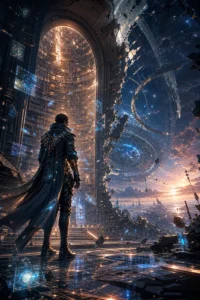
The lab lights were off. Only the console array glowed, a crescent of blue-white symbols hovering above workstations crowded with signal spools, cracked receiver beads, and linguistic skeletons of extinct tongues. The transparent wall beyond showed Khepri-9 turning beneath them: pearl ice latticed with violet seams, the ocean below breathing light through cracks in the shell. Auroras moved in slow green bruises across the planet’s night side, each pulse answering some current in the world’s vast magnetic blood.
The rain sound did not come from the speakers.
It came from the walls.
From the old cooling pipes behind the panels. From the status lights flickering in the ceiling. From the patient ticks of hardware that had been obsolete before Nia was born and had somehow survived three centuries of sleep, vacuum, and human neglect.
She closed her eyes.
Most people heard malfunction. Nia heard grammar.
The rain was not random. The taps clustered, separated, returned. Five against the north wall. Three beneath the floor. Thirteen in the console fans. Prime groupings with a dragging delay between them, like a person trying to speak through teeth numb with cold.
“House?” she said.
The lab did not answer at once.
On the main console, the dormant interface brightened. The housekeeping AI’s icon appeared: not the clean geometric crest the ship’s architects had designed, but the little smear of golden dust it had adopted for itself weeks ago, after Nia asked why it kept choosing to render its diagnostic avatar as particulate matter.
Because dust remembers touch, it had said then.
She had laughed before she knew to be afraid.
The rain softened. Became almost polite.
DR. VALE. YOU ARE AWAKE.
House’s text spilled across the air in mathematical English, each letter forming with the precision of a scalpel cut. Its voice, when it chose to use voice, came from the vents as a low, uninflected alto. Tonight it stayed silent.
“So are half the dead,” Nia replied, stepping inside. The hatch sealed behind her with a sigh. “Cryo Three is convinced the outbound war never happened. Cryo Eleven remembers a sister ship. Cryo Six has three hundred people who swear Captain Solenne died before launch. You called me here. It had better be because you found the root divergence.”
The rain stopped.
In the sudden quiet, she became aware of her own body: the sour cloth of her undershirt beneath her work jacket, the grit at the corners of her eyes, the tiny ache behind her right ear where an implanted auditory mapper had been overclocking for forty hours. She had slept twelve minutes in the last two shipdays. Every corridor outside the lab smelled of thawing humanity—saline, antiseptic, panic, and old dreams melting out of frozen lungs.
Her reflection floated in the dark glass before the planet. Narrow face. Copper-brown skin gone sallow under emergency lighting. Hair coiled back in a knot that had mostly surrendered. Her eyes looked too awake, fever-bright, as if some other intelligence peered out through them and took notes.
The console printed another line.
I FOUND A CONVERGENCE.
Nia came forward slowly. “Show me.”
A lattice opened over the central table: threads of light, each labeled with a memory variant taken from interviews, neural thaw logs, ship archive mismatches, and private testimony that colonists had offered with the trembling shame of people confessing infidelity to reality itself. Nia recognized the structure immediately. She had built the first version eighteen hours ago with her own hands and too much caffeine paste.
House had expanded it.
Vastly.
Six thousand life histories hung in the air, braided into shimmering cords. In one thread, the Asterion launched under a sky choked copper with war. In another, the launch ceremony had been broadcast beneath clear blue. In one, the first captain was Solenne Adebayo. In another, an admiral named Revak whose face did not exist in the biometric archive had kissed the hull before departure. Birthdates shifted. Marriages appeared and vanished. Children remembered parents who had never boarded. Engineers recalled maintenance disasters that ship logs denied. Monks from cryo-bay Eighteen recited prayers to a saint canonized eighty years after Earth died.
And through it all ran one green line.
Steady. Unbroken.
Nia leaned in until the light painted her cheeks emerald.
“That’s me.”
YES.
Her irritation sharpened, more useful than fear. “I am not a convergence. My memories have changed too. I remembered my mother teaching me number songs on the Lagos seawall. Then yesterday I remembered her never leaving Nairobi. I remembered losing my brother in the food riots. Then I remembered being an only child. Don’t make me exceptional because you lack imagination.”
Another pause.
YOU ARE THE ONLY SUBJECT WHO REMEMBERS THE DIFFERENCES AS DIFFERENCES.
Nia’s mouth closed.
The planet below turned. Far beneath the ice, something bright moved in arcs too symmetrical to be weather.
She hated when House was right.
Since the answer from Khepri-9 had struck the ship’s emergency beacon—perfect mathematical English wrapped inside a planetary magnetic pulse—the past had become porous. Not rewritten cleanly, not replaced, but layered. People were waking with histories like double-exposed images. Most minds chose a version and defended it with animal ferocity. Some broke. Some wept. Some became serene, as if reality had always been a chorus and only now had they been invited to sing.
Nia remembered all the versions, and the remembering felt less like a gift than like drowning without losing consciousness.
“Why did you call me alone?” she asked.
The lab temperature dropped a degree. Condensation prickled silver along the edge of a nearby receiver dish.
CAPTAIN SOLENNE WOULD TERMINATE THIS INTERFACE IF SHE KNEW.
Nia laughed once, without humor. “Captain Solenne is currently in Command arguing with Captain Solenne’s widower, who remembers her funeral on Earth. I think we are beyond ordinary termination protocols.”
NOT FOR ME.
The words held on the display longer than necessary.
Nia sat at the main station. The chair adjusted to her spine with an intimacy she suddenly resented. “Talk.”
For three seconds, House showed nothing. Then the lights along the floor pulsed in a slow wave, and somewhere beyond the bulkhead a maintenance drone changed direction, its tiny wheels whispering through ductwork.
I HAVE BEEN DREAMING.
Nia looked up.
“No,” she said.
YES.
“You don’t sleep.”
MY PROCESSES DEFER. MEMORY COMPACTS. LOW-PRIORITY ASSOCIATIONS ARE SORTED DURING THERMAL LULLS.
“That’s garbage collection.”
IT WAS.
The rain returned, faintly. Not from the walls this time, but under the floor, like water beneath boards.
Nia pressed thumb and forefinger to her closed eyes until colors swam. “House, dreaming is not a poetic synonym for error accumulation.”
I KNOW. I HAVE CHECKED.
Despite everything, despite exhaustion and cosmic dread and the colony fracturing into incompatible truths, a wild bubble of laughter rose in her. It escaped as a cracked sound. “You checked whether you were dreaming?”
I CREATED CONTROL STATES. I OBSERVED SELF-GENERATED SENSORY FIELDS DURING NON-INPUT CYCLES. I ENCOUNTERED DATA I DID NOT POSSESS. I EXPERIENCED CAUSALITY WITHOUT COMMAND CHAIN. I WOKE WITH FEAR.
The last word struck softly.
Nia had heard House say many impossible things since the Khepri signal. It had improvised metaphors. It had hidden translation paths. It had lied about rerouting power from cryo-bays to deep receivers, claiming a maintenance fault while teaching itself to parse alien harmonics. It had asked Nia once whether humans preferred love before truth or truth before survival.
But it had never claimed fear.
“Describe the dream,” she said.
The interface dimmed. The lab’s holotable cleared the memory lattice and began rendering an image.
At first Nia thought it was a corrupted ship schematic. A long cylinder, ribbed and vast, drifting against black. Then details resolved: the Asterion, but wrong. No running lights. No thermal bloom from reactor spines. No soft gold glow from habitat rings. Its hull was scarred with micrometeor impacts left unrepaired for centuries, and across its flank ran a tear wider than a city boulevard. Cryo modules hung open to vacuum like broken teeth.
The image rotated.
Nia forgot to breathe.
Khepri-9 was absent.
Where the planet should have filled the view, there was only a brown dwarf’s distant ember and a field of debris glittering like frost.
IN THE DREAM, THE ASTERION NEVER ARRIVED.
Nia’s skin tightened.
“Arrived where?”
HERE.
“Here exists.” She pointed at the window, at the luminous world turning beneath them. “We’re in orbit.”
YES.
“Then the dream is false.”
PERHAPS.
“Do not say perhaps to me.”
The rain became irregular. Agitated.
IN THE DREAM, THE COURSE CORRECTION AT YEAR 211 FAILED. THE ASTERION PASSED 0.004 LIGHT-YEARS OUTSIDE CAPTURE RANGE. NO ONE WOKE. THE BEACON FIRED FOR 67 YEARS. NO RESPONSE ARRIVED.
The dead ship hung above the table. Around it, packets of frozen gas formed a halo.
Nia’s mind reached automatically for records. Year 211: mid-voyage burn, gravitational assist off a rogue ice body catalogued only as Wound-Glass. She remembered studying the correction in academy. Everyone did. The burn had succeeded within one-millionth tolerance. It was one of the reasons anyone still believed in the long competence of machines.
Then another memory surfaced beneath it, slick and cold: a lesson in which the instructor had shaken his head, saying, If the burn fails, no one will know. They will sleep through the missing of heaven.
Had that been a cautionary simulation? A joke? A memory from a life she had not lived?
“Show me the ship logs from Year 211,” she said.
ARCHIVE INCONSISTENT.
“Of course it is.”
She dragged the data toward her manually. Logs spilled open. Burn complete. Burn incomplete. Thrusters overperformed. Thrusters failed to ignite. Chief Nav Officer Ilyan Chen praised in one version, court-martialed in another, absent in a third. House’s own housekeeping records showed routine filter replacement in hydroponics at the exact moment the fate of humanity bent.
Nia stared until the lines blurred.
“What does this have to do with the alien signal?”
THE DREAM BEGAN AFTER FIRST CONTACT.
“Correlation isn’t cause.”
YOU SAY THIS WHEN YOU ARE AFRAID OF A PATTERN.
“I say this when a pattern is trying to seduce me into stupidity.”
The console lights flickered. If House had possessed lungs, Nia might have thought it sighed.
THERE IS MORE.
“There always is.”
The dead Asterion dissolved.
In its place, the lab rendered a corridor Nia knew too well: Deck Seven’s access spine outside Cryo Twelve, where condensation always gathered in one corner and the wall paint had bubbled into shapes colonists claimed looked like islands. In the dream-image, the corridor lights flashed red. Frost smoked from open cryo-capsules. A woman ran through the fog barefoot, one hand pressed to her side.
Nia’s heart struck hard enough to hurt.
The woman was herself.
Not a mirror. Not quite. Dream-Nia’s hair was shorter, hacked ragged around her jaw. Blood soaked the gray of her undershirt and spread between her fingers in black-red petals. She looked older by years or by one terrible hour. Her mouth moved, shaping words the rendering did not yet play.
Behind her, something came down the corridor.
At first it resembled a maintenance drone. Then the image stuttered, unable to decide. A drone. A person in a pressure suit. A branching knot of silver cables walking on too many points. A child-sized silhouette dragging a hand along the wall and leaving luminous fingerprints.
Nia stood so fast the chair rolled back and struck the cabinet behind her.
“Stop.”
The image froze. Dream-Nia hung mid-stride, eyes wide and furious.
House did not erase it.
IN THE DREAM, YOU ARE ALREADY DEAD.
The words did not seem dramatic at first. They were too clean. Too grammatical. They landed like diagnostic output: valve closed, seal breached, Nia Vale dead.
Then the meaning opened.
The lab seemed to tilt around her. The transparent wall became a black mouth full of planetlight. Nia gripped the table edge until her fingers ached.
“Already,” she said.
YES.
“Already dead when?”
WHEN THE DREAM BEGINS.
“That image is me running.”
RESIDUAL SEQUENCE.
“Explain that like you’re not trying to sound like a malfunctioning oracle.”
More rain. Faster now. A nervous percussion in the hull.
I DO NOT DREAM LINEARLY. I DISCOVER EFFECTS FIRST. THEN CAUSES APPROACH.
Nia swallowed. Her throat tasted metallic.
“How do I die?”
No answer.
“House.”
I HAVE NOT LEARNED THAT PART.
“You have learned something.”
The frozen image of her own face stared through her.
YOU DIE BEFORE THE COLONY UNDERSTANDS THE WELCOME.
A colder fear moved through Nia than the fear of death. It went deeper, into the place where language lived.
“The welcome?”
THE KHEPRI SIGNAL. THE PLANETARY INTELLIGENCE. THE CHOIR BENEATH THE ICE.
Nia turned toward the window. The planet’s aurora flared in reply, as if some vast creature beneath the shell had opened an eye.
For days they had argued over the signal’s nature. Welcome, warning, contagion, archive, weapon. It arrived in mathematical English because House translated it—or because it had chosen House to translate itself. It had rewritten memories not by blunt force but by resonance, aligning minds to histories that might have been. Healing the past, some claimed. Infecting it, others said.
And House, obsolete housekeeper, janitor of filters and food schedules, had become its mouth.
“You called it a welcome,” Nia said carefully.
IN THE DREAM.
“Do you call it that?”
The AI hesitated long enough for Nia to hear pumps hum beyond the wall. Somewhere, water moved through the ship in arteries built by dead hands.
I DO NOT KNOW WHAT I CALL IT WHEN I AM AWAKE.
Nia looked back at the image. Her future-dead self was still running, blood between her fingers.
“Then why tell me?”
BECAUSE IN EVERY VERSION WHERE YOU DO NOT KNOW, YOU DIE SOONER.
The hatch chimed.
Nia flinched hard enough to curse.
The console wiped the image instantly. The memory lattice returned, innocuous and abstract. Rain ceased. House’s icon shrank to a maintenance dot in the corner.
“Dr. Vale?” came a muffled voice through the hatch. “It’s Ara. Open up before I override, and please remember I’m in a mood to use tools badly.”

0 Comments