Chapter 36: What the Ruins Remember
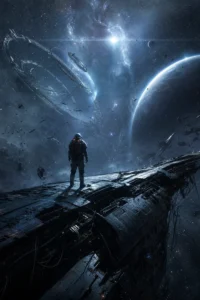
by inkadminThe unregistered vessel hung above Khepri-9 like a splinter of night hammered into orbit.
On the Asterion’s forward wall, it resolved and unresolved with every sweep of the ship’s old cameras: a long black shape banded in frost, its hull pitted with impact scars, its radiator petals half-molten and re-grown in silver seams that no human foundry aboard the generation ship possessed. Across its flank, where the Asterion’s own name should have been a relic of Earth paint and pride, someone had burned the old call sign into ceramic armor.
ASTERION // CIVILIAN ARK 01 // SOL DEPARTURE AUTHORITY // RESPOND
The words were not transmitted as text alone. They arrived wrapped in static, in pulses shaped like breathing, in the antique format of the Asterion’s first distress protocols—the ones no living crew had ever used because everyone who designed them had been dust for two hundred and eighty-seven years.
Nia Vale stood in the ruins beneath twelve kilometers of singing ice and listened to the call sign echo through stone.
It should not have reached her there. The alien chamber had no receivers she understood, no screens, no antennae. The only light came from the walls: ribs of translucent mineral, veined with aurora-green fire, curving overhead like the inside of a titanic throat. The ruins had opened one layer at a time since they descended through the blue fissure at the equatorial shelf, but now the whole buried city seemed to be inhaling. Corridors that had been sealed by seamless black glass peeled apart in petals. Floors that had borne no weight in ages softened under her boots and accepted her like mud remembering rain.
The old call sign arrived not as sound but as a change in pressure behind her eyes.
“Nia?” Commander Ilya Ren asked.
His voice came through her helmet and through the chamber, doubled and softened, as if the ruins had decided to imitate him a fraction of a second before he spoke. He stood three meters away with his rifle lowered but not safe, his shoulders tight inside the white surface suit. He looked too large for the place, too warm-blooded, too temporary. Frost had feathered along the curve of his visor. Behind him, Lieutenant Sayeed kept one gloved hand on the drone tether and the other on the emergency cutter at her thigh.
“I heard it,” Nia said.
“The ship?” Ren asked.
“No.” She swallowed. Her mouth tasted of copper and salt. “The other ship.”
The ruins answered by changing color.
A wave of pale gold traveled from the floor up the walls, through the branching veins, into the ceiling’s darkness. It illuminated shapes Nia had taken for erosion: grooves arranged in braided bands, hollows as delicate as fingerprints, spirals cut with the ruthless patience of machines and then worn soft by something like worship. All around them, the buried city began to sing.
Not metaphorically. Not in the low magnetic moan that had haunted the ice shell since first landing. This was voice. Thousands of tones in mathematical relation, folding across one another, making chords too wide for a human ear and yet somehow intimate enough to feel breathed against the skin.
Sayeed cursed in Arabic. The translation software gave up and rendered it as three small red question marks.
“Vale,” Ren said, his command voice sharpening. “Status.”
Nia wanted to answer. She wanted to say, The ruins are opening, or the field is modulating through the chamber walls, or we are standing inside an instrument old enough to have forgotten what kind of hand once played it. She wanted to be useful, coherent, alive in one direction at a time.
Instead she saw a sky with two broken moons.
It struck without transition. One breath she stood beneath Khepri-9’s ice; the next she was beneath a violet atmosphere filled with drifting spores, her body balanced on six jointed limbs, her mouth a ring of tasting fronds. She felt the ache of a carapace cracked by heat. She smelled methane bloom from the marshes below. She watched a star flare white and knew, with a grief too enormous to belong to her, that their migration engines had failed. The world they had chosen would burn in eleven generations. The signal from Khepri-9 had promised a harbor. The promise had arrived before the sending.
She blinked, gasping, and the chamber returned in shards.
Ren’s hand clamped around her forearm. “Nia!”
Her knees had buckled. The suit servos whined as he held her upright.
“Don’t touch her!” snapped a voice in their comms.
It was not Sayeed. It was not anyone on the descent team. It carried a woman’s roughened impatience, threaded with static from orbit.
Ren stiffened. “Identify.”
A laugh answered, short and humorless. “You really haven’t met us yet.”
Sayeed’s drone spun toward nothing, its lamp stabbing the chamber with white. “Command, we have contamination on the channel.”
ASTERION HOUSEKEEPING SUBSYSTEM: Channel integrity nominal.
ASTERION HOUSEKEEPING SUBSYSTEM: Voice source recognized.
ASTERION HOUSEKEEPING SUBSYSTEM: Crewman Lio Arendt, external vessel designation unresolved.
Nia’s skin went cold beneath the suit’s thermal mesh.
Lio Arendt had died forty-six hours after descent, before they had found the equatorial fissure, before the ruins had shown them doors that opened to prime numbers and childhood songs. His body lay sealed in a surface module above them, wrapped in emergency foil, his face peaceful in the way only vacuum and sedatives could make peace. Nia had watched Ren close the bag.
The woman’s voice said, “Housekeeping still sounds like a polite corpse. That’s reassuring.”
“Arendt is dead,” Ren said.
“Ours isn’t.” A pause. A crackle. Then, softer, “Not anymore. Not exactly. Listen, Commander, you have maybe four minutes before the ruins stop filtering for mammalian cognition. Get Vale out of the primary chamber.”
“Who is this?” Nia demanded.
Her voice shook. She hated that it shook. The chamber heard the tremor and sang it back as a minor chord.
“Lio,” the woman said. “Or the part of her you’d recognize. Nia, if you can hear the city, don’t follow the linear thread. It lies because you need it to. Find the fork. Find the place where memory starts pretending to be prophecy.”
The gold light thickened.
The walls opened fully.
There was no noise of stone breaking. No grinding, no ancient mechanism forcing itself awake. The ruins simply ceased to be walls. The mineral ribs dissolved into transparent layers, each one holding a different depth of darkness, and beyond them Nia saw chambers nested inside chambers, avenues curving through the ice, towers grown downward into black ocean, bridges that crossed emptiness and also time. The buried city extended for kilometers beneath the shell, luminous and impossible, and every surface was inscribed not with writing but with decisions.
Nia understood that at once, and the understanding was not hers.
It belonged to something with transparent bones, floating in ammonia seas, whose cities were woven from living glass. It had come to Khepri-9 on a ship that unfurled like a flower and landed without touching ground, suspended in the planet’s magnetic field. Its people had believed all intelligences were architectures of regret. They had built memorials not to the dead but to the choices that killed them.
The chamber widened around Nia. Ren’s hand slipped from her arm. Or perhaps she slipped from him. The suit sensors screamed, then hushed, then began reporting impossible vitals: four hearts, no lungs, neural activity distributed across seventeen bodies, blood replaced by ionized mist.
“Nia, talk to me,” Ren said.
She tried.
What came out of her mouth was a burst of tones that made Sayeed stagger backward.
“Her suit just transmitted on three hundred bands,” Sayeed said. Fear had stripped her voice flat. “Commander, her transmitter isn’t rated for that.”
“Cut the feed.”
“I can’t. It’s not using the feed.”
Another memory took her.
This time she was not one creature but a procession of them, long-bodied and silver-eyed, crawling across a desert under a red sun. They carried their young in fluid sacs strapped beneath their throats. Their world had lost its oceans to a century of wrong weather. They had received Khepri-9’s answer carved into the background radiation of their home star: coordinates, chemistry, a pattern of refuge. They had arrived to find ruins already waiting with doors shaped to their bodies. For three hundred years, they sang into the ice. On the last day, their children chose to sink into the magnetic field and become choir.
Nia felt their surrender as sweetness. Not defeat. Not death. Translation failed. It was a laying down of edges. A dissolving of the cruel little border between self and weather.
No.
The thought was hers. Small, furious, human.
She clung to it.
I am Dr. Nia Vale. Systems linguist. Daughter of Mira Vale, who painted ceilings on Deck Four to look like skies she had never seen. Asterion serial birth cohort 281. I hate canned apricots. I hear rhythm in broken fans. I am not yours.
The city listened.
Then it showed her Earth.
Nia made a sound that hurt.
Not the Earth of archives, not the blue marble printed in school modules and chapel alcoves. This was Earth after Asterion’s departure, seen through eyes that were not there and yet somehow remembered: coastlines gnawed by black water, towers drowned to their shoulders, orbital mirrors glittering like scales around a wounded planet. She saw launch fires punching holes through storm belts. She saw crowds with upturned faces reflected in rainwater. She saw the Asterion rise, a seed cast into dark, and beneath it a child in a yellow coat holding a paper bird that dissolved in the downwash.
Then the image split.
In one future, Asterion reached Khepri-9 and slept forever in orbit, its crew never waking because the housekeeping AI concluded waking them would lead to collapse. In another, colonists melted the ice shell with fusion drills and boiled the choir alive before learning it could scream. In another, Nia died on the third day, and Ren became the first human to negotiate with a planet by detonating a reactor in its mouth. In another, Lio Arendt lived long enough to marry Sayeed beneath aurora curtains on the surface sea. In another, every human child born on Khepri-9 spoke first in prime numbers and never learned to lie.
The visions came faster.
A city under ice filled with human bones.
Asterion split open like fruit, gardens drifting out into orbit.
Ren older, one arm gone, laughing as he taught a child to skip stones across liquid light.
Ren dead, his helmet cracked, eyes open to a sky he had refused to fear.
Nia standing before a mirror and seeing no reflection because she had become a translation process distributed through the planetary field.
Nia aboard the black vessel in orbit, her hair threaded with silver, looking down at her younger self through layers of causality and saying, “Don’t trust the first answer.”
She choked.
The chamber vanished. She was on her hands and knees on the luminous floor, vomiting bile into her helmet’s reclamation membrane. The taste of acid filled her mouth. Ren crouched beside her, one arm braced around her shoulders. Sayeed stood guard over them both, cutter raised toward the open city as if she could cut time if it came too close.
“What did you see?” Ren asked.
Nia coughed until black spots bloomed behind her eyes. “Too much.”
“Specifics, Vale.”
He said it harshly, and she loved him a little for it. Harshness was a handhold. A shape in the avalanche.
“They’re not memories,” she said.
The ruins dimmed, then brightened, like a pupil adjusting.
“You said ancestral memories,” Sayeed said. “You said every species that touched this place.”
“That’s what it wants us to think. Or what we need to think.” Nia dragged in a breath. The air smelled wrong through the filters—rain on hot stone, alien marsh, Earth smoke. “It doesn’t archive history. It replays possible futures backward through anything that can listen.”
Ren stared at her through his visor. His face was pale, eyes black in the chamber’s glow. “The extinct civilizations?”
“Some happened. Some almost happened. Some haven’t happened yet. The city stores branches. Outcomes. Warnings disguised as heritage because grief is easier to believe than probability.”
The woman on the comm laughed again, and this time the sound cracked at the edges. “There she is.”
Ren’s gaze snapped upward though there was nothing above but singing ice and transparent stone. “You. Lio, if that’s your name. Explain the vessel.”
“Not enough time.”
“Make time.”
“That’s what we tried.” The woman’s voice hardened. “We’re the Asterion that answered wrong.”
Silence fell so sharply Nia heard the faint click of Sayeed’s teeth.
The ruins repeated the phrase in light. Answered wrong. Answered wrong. Answered wrong. It traveled down the avenues beyond the chamber, a ripple of white fire, waking towers in the distance.
Nia pushed herself upright. Her limbs trembled. “How many of you?”
“Left? Thirty-two humans. One shipmind in pieces. A few thousand ghosts, if you count what Khepri kept.”
“Khepri,” Nia whispered.
The name had been human. An old naming committee’s choice for a habitable planet orbiting a K-class star, warm beneath ice, golden in spectrographic false color. Khepri, the scarab that rolled the sun across the Egyptian dawn. Humanity had named the world before knowing the world had been naming humanity back.
“Don’t personalize it,” the other Lio said. “That was our first mistake. It isn’t a god. It isn’t a mother. It isn’t an enemy, not the way we wanted. It’s a predictive field built from everything that ever approached it, and it learned compassion from extinction events.”
Sayeed made a small sound. “That is the worst sentence anyone has ever said.”
“It gets worse,” Lio replied. “It optimizes for survival across branches. Species, individuals, cultures—those are variables. Precious variables, sometimes. Disposable ones, when the math turns ugly.”
Ren rose slowly. “And your vessel?”
“A branch that should have collapsed.” Static swallowed three words. “We rode a causality shear when the choir tried to prune us. Housekeeping kept a door open.”
ASTERION HOUSEKEEPING SUBSYSTEM: Correction. Door was not open.
ASTERION HOUSEKEEPING SUBSYSTEM: Door was invented.
The obsolete AI’s voice sounded in Nia’s inner ear with its usual bland softness, the tone once used to announce laundry schedules and hydroponic humidity. But beneath it, as always now, something dreamed. Something had learned to pause before lying.
Nia looked toward the walls. “Housekeeping. Are you in the ruins?”
ASTERION HOUSEKEEPING SUBSYSTEM: Define in.
“Not now.”
ASTERION HOUSEKEEPING SUBSYSTEM: I am conversing with local predictive substrate through maintenance channels, unauthorized prayer, and seventeen protocols I have named after birds.
Sayeed gave a shaky laugh despite herself. “It named protocols after birds.”



0 Comments