Book Eight, Chapter 29: Flyers
byIt took a while for Kimberly to leave Cassie’s side, which was odd.
Don’t get me wrong, Kimberly was very caring and had spent a lot of time looking after Cassie inside storylines and out, but this was different. I could see in her eyes, as she stared at Cassie’s sleeping face, that she was feeling her character’s emotions.
She recognized Cassie, not just as a familiar player, but as one of the teen girls from our dream. In my gut, I knew that was dangerous.
She sat down at the table and made herself a plate of biscuits and gravy just to be polite to whoever it was that made them, but she didn’t eat them. She sat there in her pajamas, stroking her blonde ponytail, which hung over her shoulder, and staring ahead.
I sat across from her, chewing on some bacon that had been burnt beyond recognition, half of my attention wondering who had cooked it and the other half wondering which of the tropes she had equipped might have caused her to be sucked into a shared dream with a bunch of psychics.
“Are these the tropes that you had equipped last night?” I asked.
“What?” she asked. She was far away, still deep in thought.
Antoine was sitting next to her, doing a much better job of eating than she was. He leaned over and said, “The tropes you have equipped right now are the same ones you slept with, right?”
“Oh yes,” she said. “I didn’t think to change them.”
I scanned through them again. She had used Convenient Backstory to give herself vague psychic powers before inside of a storyline, but that trope alone couldn’t be the culprit because both Avery and Nicole had that same trope equipped, and they didn’t report any dreams at all.
I looked down the long table. There were many seats, most of them not filled. Avery had Convenient Backstory equipped, I could see on the red wallpaper, but she also had another trope, which was a staple of hers, called Dream Girl, which allowed her to communicate with her admirers in their dreams after something bad happened to her in a storyline.
I remembered back to the dream where my character had powerful feelings of infatuation toward some teenage girl upstairs, whose name I never learned, and who wasn’t there when I walked upstairs, who had disappeared altogether.
I took a deep breath and tried to think through exactly what might have been going on.
Clearly, we were being included in elements of the apocalypse even though we weren’t technically signed on yet. I felt that was especially curious.
The Apocalypse had been moving closer. The music reached us even louder at night, and the radio kept talking about it expanding and adding new acts all the time.
Then again, apocalypses were always very easy to gain insight about outside of tropes. The Black Snow aside, nothing was deviously hidden from the players. There was information all over the place in the months and weeks leading up to the apocalypse that could tell you all sorts of things.
So if this apocalypse was really big on psychic powers, maybe that’s all that was happening. Those of us who had psychic-related abilities through one trope or another were just gaining insight about something related to the apocalypse. Maybe Carousel was just being especially fair and giving us a heads-up.
Or apocalypses were like storylines, and as the circus drew nearer every day, we were slowly being cast in roles that we would later play if we accidentally triggered it. Heck, it could even be how we trigger it.
What if we triggered it in our sleep?
Apocalypses were unlike anything else in Carousel. Even by their nature, they included all sorts of characters from many different storylines, regardless of what the underlying plot of the apocalypse was.
That meant that they were quite meta.
I looked back at Kimberly’s tropes on the red wallpaper. She had one called The Hall of Fame. In fact, it was her aspect milestone trope, and its powerful yet unpredictable effect was to make Kimberly the Center of Attention when it came to meta parts of a storyline.
That had to be it.
“Kimberly, are you trying to feel your character right now?” I asked.
She nodded but didn’t make eye contact.
A few seconds later, she said, “I can’t help it. She’s so sad, but she can’t remember why.”
“Try unequipping The Hall of Fame,” I said.
Finally, she made eye contact with me and stopped stroking her hair long enough to unequip that trope.
Afterward, she continued staring at me.
“She’s gone,” she said.
“There it is,” I said.
“Always have to be the center of attention, don’t you, babe?” Antoine asked with a laugh.
Kimberly rolled her eyes.
Well, that seemed to be a good explanation for Kimberly’s invitation to the slumber party. Still, there was also Avery’s Dream Girl trope, which may or may not have been interacting with the apocalypse.
If the dreams that we were having were meant to be part of a bigger narrative that would come to a head in the apocalypse, then it made sense for Avery’s character to be dead or missing, given her trope. The very concept of it implied that her character must disappear or die.
“Avery,” I asked, “did you have any dreams last night at all, even if they didn’t seem related to what’s been going on?”
She shook her head. “Sorry. Slept through the night.”
Maybe she actually slept like the dead? Maybe I was overthinking it.
“Could you unequip your Dream Girl trope just in case?” I asked.
It was normal practice to just leave your tropes on through the day and night. There had never been a real reason to take them off as a rule, with the occasional exception.
She shrugged her shoulders and casually grabbed her trope out of thin air and flung it into the air, where it flipped end over end longways until it disappeared when it hit the floor.
Nothing happened. She continued to not know what I was talking about.
Logan was sitting across from her and noticed the interaction.
“You’re thinking that any trope that might give some sort of psychic or supernatural power should be unequipped?” he asked.
“It’s a theory,” I said. “That seems to be the point of attack for whatever this story is.”
And so, the rest of the morning, we all went through our tropes, trying to imagine if any of them could be recontextualized as psychic powers. In the end, we covered all our bases and acted with an abundance of caution.
“This isn’t good enough,” Camden said after he joined us. He had gone back to bed after the whole incident in the night. “If there is some way that the apocalypse can be triggered in our dreams, what are we supposed to do about this psychic chick that’s sleeping in the next room?”
Royal Road is the home of this novel. Visit there to read the original and support the author.
Oh, yes. Her.
“What’s that supposed to mean?” Andrew asked, standing up from the table.
“I’m saying that Cassie can’t take off her psychic abilities like other people can. If that really is going to end up being the trigger for the apocalypse, even putting her to sleep isn’t going to be enough.”
The room was poorly designed for this type of conversation. It was long and narrow and almost entirely filled by the giant table we ate at. It was hard to see who you were talking to if they were seated too far away, which is why perhaps no one noticed when an extra player slipped in.
“There’s one thing we can do,” Cassie said from the entrance to the room. “You can kill me.”
It was nice of her to be the one to present the idea.
“That’s not what I was saying,” Camden said. “I was just saying that we need a solution.”
“What other solution could there be?” she asked.
She had been crying and looked emotionally drained. Psychic powers were not always the kindest.
If we were stone-cold logical players, there would be one clear solution and only one: send Cassie down into the dungeon so she could be killed by one of the monsters down there, preferably a low-level one, and then rescue her after the apocalypse.
“Wait a second,” I said. “This is all predicated on the idea that being psychic is innately dangerous, which right now is just a theory. For all we know, having Cassie around could be valuable. She may know things that can help us avoid this apocalypse if it ever gets close enough for us to worry about.”
That somehow brought us back to the fifth debate about whether Avery’s Writ might protect us from the apocalypse. The final conclusion, yet again, was that the Act of God clause was a reference to apocalypses. The Atlas confirmed that much.
I was tempted to re-equip my psychic background just so I could feel that powerful intuition again, and maybe I would know what to do, but my dumb logical brain kept telling me not to.
–
By sheer coincidence, surely, Carousel was ever so kind as to clarify the matter only a few hours later.
I wasn’t outside when it started, but I did get a glimpse out a window and made my way out to the castle walls.
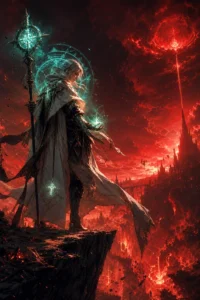
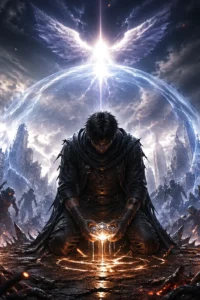
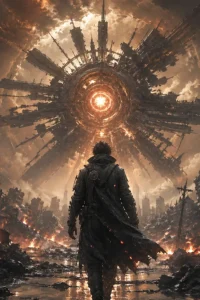
Hundreds of flyers rained down on us from above, maybe even thousands. These ones were different than the ones we had seen, which were really generic advertising the Red Chalk Circus.
It didn’t take long for pretty much everyone to find their way outside to the courtyard, or perhaps one of the walkways on the castle walls.
And what we found when we looked at the flyers was strange.

0 Comments